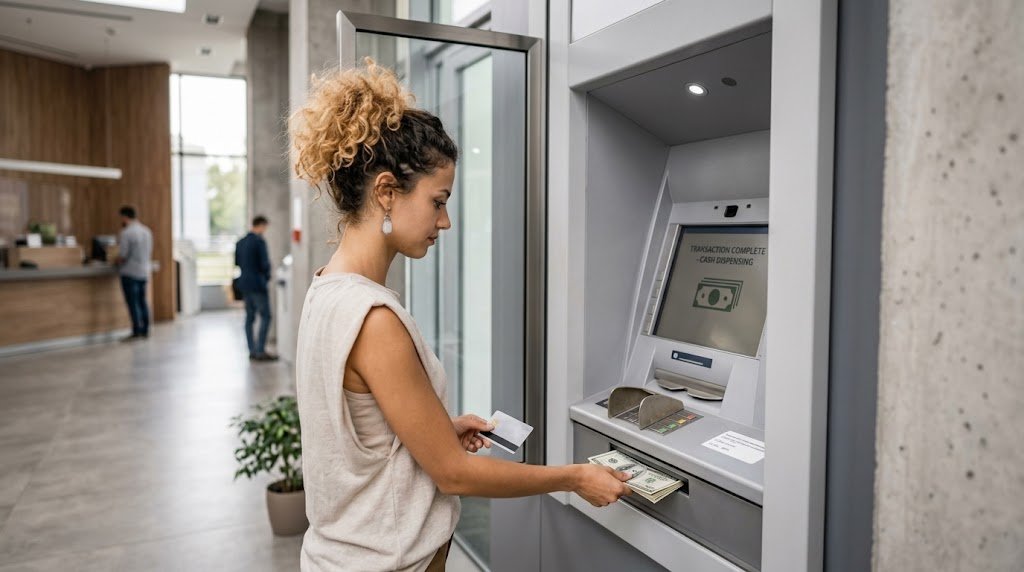
Cash Advances Explained: Why This Is the Most Expensive Way to Get Cash From Your Card
Short on cash and your credit card lets you withdraw money from an ATM — it feels like a simple solution. But cash advance fees, combined with how the interest works, make this one of the most expensive ways to borrow money. The cost isn’t always obvious until the statement arrives.
What a Cash Advance Actually Is
A cash advance lets you withdraw cash using your credit card, either at an ATM or through a bank teller, treating your card’s credit line like a mini loan. It sounds convenient, but it’s structured very differently from a normal purchase — starting with the fee attached to it.
How Cash Advance Fees Actually Work
The Upfront Fee Comes Before Any Interest Even Starts
Most issuers charge either a flat fee, often around $10, or a percentage of the amount — typically 3% to 5%, whichever is higher. Withdraw $500 at a 5% fee, and you’ve already paid $25 before a single day of interest accrues. This is what makes cash advance fees so different from a regular purchase: you’re charged just for accessing the money, before any interest even enters the picture.
Interest Starts Immediately, With No Grace Period
Regular purchases usually come with a grace period, meaning no interest accrues if you pay your statement balance in full by the due date. Cash advances don’t get that benefit. Interest starts accruing the moment the cash leaves the ATM. If you’re unfamiliar with how a grace period works on normal purchases, the credit card grace period guide explains the difference clearly.
The APR Sits Well Above Your Regular Purchase Rate
On top of the upfront cash advance fees, the interest rate itself is usually higher than your regular purchase APR — commonly in the 25%–30% range. Because this rate compounds daily with no grace period, the effective cost adds up faster than it looks on paper. The credit card interest calculation article breaks down exactly how daily compounding works, which is worth understanding before assuming a cash advance is a quick, low-cost fix.
How Widespread Cash Advance Fees Really Are
A CFPB data spotlight found that cash advance fees often run the greater of $10 or 5% of the transaction, with a common APR of 30% — and that roughly 23 million US households pay these fees in a given year. That’s not a niche cost, it’s a widespread one, often triggered by situations that feel urgent in the moment.
A Real Example of Cash Advance Fees Adding Up
Say you take a $500 cash advance with a 5% fee and a 28% APR. You’re charged $25 upfront. If it takes two months to pay it off, interest alone could add roughly $20–$25 more, depending on your balance and payment timing — meaning you could pay $45–$50 total to access $500, all before accounting for any ATM fee charged separately by the machine itself.
What to Use Instead of Paying Cash Advance Fees
An Emergency Fund
The most reliable alternative is having cash already set aside so you’re not relying on your credit card at all. Keeping that fund in a high-yield savings account means it earns something while it sits there, unlike cash under a mattress.
A Personal Loan
If you need a larger amount and have some lead time, a personal loan often comes with a lower, fixed rate than a cash advance carries. The secured vs. unsecured personal loans comparison can help you figure out which type fits your situation.
Negotiating With Existing Creditors
Sometimes the actual need isn’t cash itself, but a way to cover an upcoming bill. In that case, it may be worth exploring whether a payment plan or a lower rate is possible before taking on a cash advance and its fees. The negotiate credit card interest rate guide has a practical starting script for that conversation.
Common Mistakes People Make With Cash Advances
Assuming it works like a regular purchase
No grace period and a higher APR make a cash advance fundamentally different from swiping your card at a store.
Not checking the cash advance limit
Your cash advance limit is often lower than your total credit limit, so attempting to withdraw more than allowed can result in a declined transaction and a wasted trip to the ATM.
Using it repeatedly instead of addressing the root issue
If cash advances are becoming a recurring pattern, it may point to a bigger gap in the budget worth addressing directly. The debt-free journey article offers a starting framework for breaking that cycle.
Forgetting the ATM fee stacks on top
Beyond the issuer’s own cash advance fees, the ATM itself may charge its own fee — meaning the total cost is often higher than people expect going in.
Final Thoughts
Cash advance fees can feel like a small price to pay for fast access to cash, but between the upfront charge, the immediate interest, and the higher APR, the real cost adds up quickly compared to other borrowing options. Building even a small emergency fund, or exploring a personal loan for larger needs, is almost always less expensive in the long run.
This article is intended for general educational purposes only and isn’t personalized financial advice. Terms vary by issuer, so check your specific card agreement for exact fees and rates.