
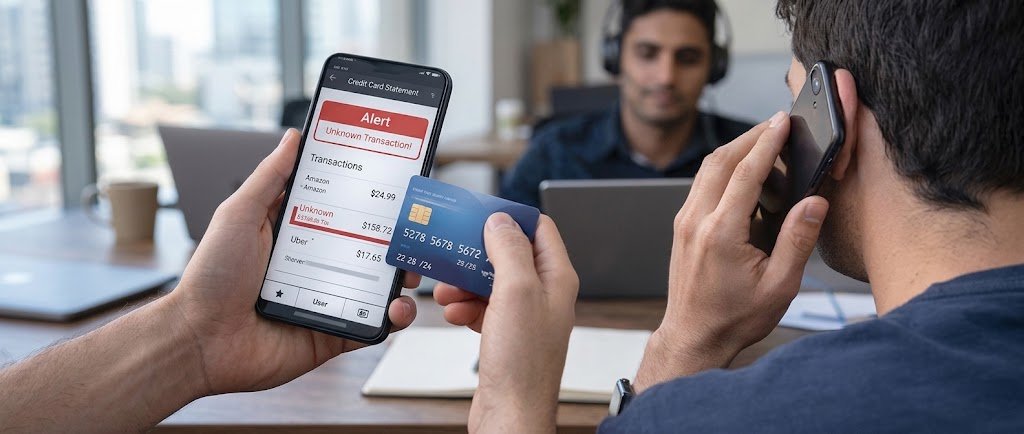
A $4.99 charge from a company you’ve never heard of shows up on your statement. It’s small enough to ignore, easy to assume it’s a subscription you forgot about. That’s exactly how a lot of fraud starts — not with a dramatic $2,000 charge, but with something quiet enough to slip past you. Knowing the real credit card fraud signs is what separates people who catch it early from people who don’t notice until the damage is bigger.
Why Small Charges Matter Most
Fraudsters often test stolen card numbers with tiny charges before attempting larger ones. If a small, unfamiliar charge appears and it’s ignored, it can be a signal that a bigger charge is coming next.
According to the FTC’s testimony before the Joint Economic Committee, consumers submitted roughly 3 million fraud reports in 2025 alone, totaling $15.9 billion in losses — a reminder that this isn’t a rare event, it’s something worth actively watching for on every statement.
Credit Card Fraud Signs to Watch For
Unfamiliar Small Charges
As mentioned above, small “test” charges are one of the earliest credit card fraud signs. If you don’t recognize a charge, even a tiny one, it’s worth investigating rather than dismissing.
Duplicate or Near-Duplicate Transactions
Seeing the same amount charged twice within a short window, sometimes from slightly different merchant names, can indicate a card number is being tested across multiple systems.
Declined Transactions You Didn’t Attempt
If your card gets declined for a purchase you never tried to make, your issuer’s fraud detection may have already flagged suspicious activity — which is worth confirming directly with them.
Alerts for Purchases in Unfamiliar Locations
A charge from a city or country you haven’t visited is one of the more obvious credit card fraud signs, especially if it appears alongside a legitimate transaction from your actual location around the same time.
Missing Statements or Mail
If a paper statement or a card renewal doesn’t arrive when expected, it’s worth checking whether someone has redirected your mail — a tactic sometimes used in identity theft.
Unexpected Autopay Failures
If a bill you have on autopay suddenly fails, it could mean your card was replaced due to a fraud flag, or that unauthorized charges pushed you over your limit. Reviewing how your autopay setup affects your credit can help you catch this kind of disruption faster.
What to Do If You Spot Fraud
Once you’ve noticed one of these credit card fraud signs, speed matters.
1. Report It Immediately
Call your card issuer’s fraud line as soon as you notice something unusual. Under federal law, your liability for unauthorized charges is limited, but reporting quickly matters.
2. Freeze or Lock the Card
Most issuers let you lock a card instantly through their app while a formal fraud investigation is opened, stopping further unauthorized use without needing to cancel the account outright.
3. Review Recent Statements Line by Line
Don’t stop at the charge you noticed — go through the last two or three statements carefully. Fraudsters sometimes make several smaller charges before a large one.
4. Set Up Transaction Alerts
Real-time alerts for every purchase, even small ones, make it far easier to catch fraud the moment it happens rather than a month later on a statement. Automating this kind of monitoring, similar to automating your finances more broadly, removes the need to manually check every day.
5. Rebuild If Needed
If a card had to be closed and reissued due to fraud, it can sometimes affect your available credit temporarily. If you’re starting to rebuild credit history from a lower point, the build credit from scratch guide covers the fundamentals.
Common Mistakes People Make
Every mistake below makes credit card fraud signs harder to catch in time.
Assuming small charges aren’t worth reporting
Small unauthorized charges are often the first sign, not a harmless mistake to shrug off.
Waiting for the paper statement
Checking your account online or through an app weekly catches fraud far sooner than waiting for a monthly mailed statement.
Reusing the same card everywhere online
Cards saved across many merchant sites increase the number of places your number could be exposed if one of those sites is breached. A secured credit card with a lower limit can be a useful option for online purchases specifically, since exposure is capped.
Ignoring alerts because they’re “probably nothing”
Fraud detection systems flag activity based on patterns, and while false positives happen, dismissing every alert without checking increases the odds of missing a real one.
Final Thoughts
Most credit card fraud doesn’t announce itself with a huge, obvious charge. It usually starts small and quiet, which is exactly why catching the early warning signs matters. Reviewing your statements regularly, setting up real-time alerts, and reporting anything unfamiliar right away are the simplest ways to keep a small issue from becoming a bigger one.
This article is intended for general educational purposes only and isn’t personalized financial or legal advice. If you believe you’re a victim of fraud, contact your card issuer directly and consider reporting it to the FTC.