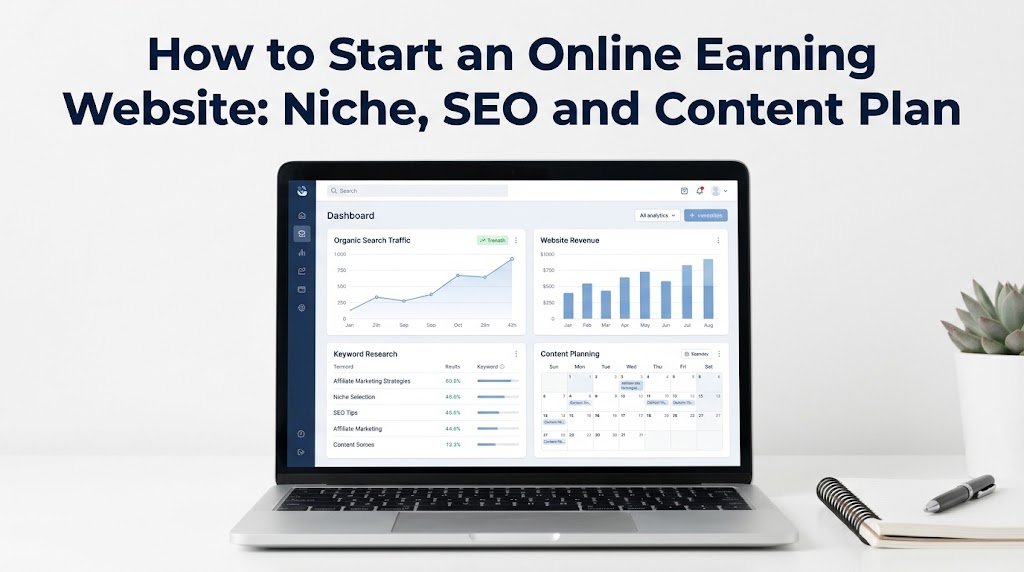
To start an online earning website, choose a focused niche, understand what your audience searches for, publish useful content, and select a suitable way to make money from that traffic. You can earn through affiliate marketing, display ads, digital products, services, or other methods, but the website should first provide useful information that people actually need.
A successful site isn’t created by publishing random articles and adding ads. You need a clear topic, a practical SEO plan, a content calendar, and a monetization strategy that fits your audience. This guide explains how to build those pieces from the ground up.
Choose a Niche With Real Earning Potential
Your niche determines what your website will talk about, who will visit it, and which monetization methods may work later. A good niche should have enough questions and problems to support many useful articles while also having products, services, or other commercial opportunities related to it.
For example, instead of targeting the huge topic “make money online,” you could focus on freelancing for beginners, remote work, online tools for small businesses, digital products, or personal finance basics. A focused topic makes it easier to understand your readers and build related content.
Before choosing a niche, consider whether people actively search for information about it, whether you can produce genuinely useful content, and whether there are realistic ways to earn from the audience. Your own knowledge and interest also matter because building a content website takes time.
If you’re still comparing different ways to earn online, an Online Earning Guide can help you understand the wider options before committing to a website-based business.
Understand Your Target Audience First
Keyword research becomes much easier when you know who you’re writing for. Think about the questions your audience asks, the problems they face, their experience level, and what they might eventually spend money on.
For example, a website for beginner freelancers could target people who want their first client. Those readers may need information about creating a portfolio, choosing a freelance platform, writing proposals, setting rates, and communicating with clients.
This gives your website a natural content path. A visitor might first read an educational article, then compare tools or platforms, and eventually take an action that generates revenue for your website.
Find Keywords Based on Search Intent
Don’t choose keywords based only on search volume. You also need to understand search intent, which is the reason someone enters a particular query into Google.
A person searching “what is affiliate marketing” wants an explanation. Someone searching “best affiliate programs for beginners” is already researching possible options. Someone searching for a specific product may be much closer to making a purchase.
Your keyword research should include different types of searches:
| Search intent | Example | Best content type |
| Informational | how to start freelancing | Step-by-step guide |
| Informational | what is affiliate marketing | Explanation |
| Commercial | best freelance websites | Comparison |
| Commercial | best website hosting | Buying guide |
| Transactional | website hosting plans | Product-focused page |
| Problem-based | how to get freelance clients | Practical guide |
Long-tail keywords can be especially useful for a new site because they often target specific questions. Instead of trying to rank immediately for “freelancing,” you might target “how to find freelance writing clients with no experience.”
Build Topic Clusters for Your Website
After collecting keywords, organize them into related groups rather than publishing unrelated articles. This creates a clear content structure and makes internal linking easier.
Suppose your website covers freelance writing. A main guide could target “freelance writing for beginners,” while supporting articles cover portfolios, finding clients, pricing, proposals, writing samples, and common beginner mistakes.
You can then connect these articles with relevant internal links. Readers get additional information without having to search for it themselves, while search engines can better understand how the pages relate to one another.
If your website will mainly rely on publishing articles, learning the basics of Blogging can also help you plan your publishing process, content categories, and reader-focused strategy.
Create an SEO Content Plan Before You Publish
A content plan keeps your website focused. Instead of opening your editor every day and wondering what to write, prepare a list of topics based on your audience’s questions and search intent.
For a new website, start with one main subject and build several closely related pages around it. You don’t need hundreds of articles immediately. A smaller collection of useful, well-connected pages can give you a much clearer starting point.
A simple four-week plan could look like this:
| Week | Content focus | Example |
| 1 | Main guide | Complete beginner’s guide |
| 1 | Supporting article | Common beginner questions |
| 2 | How-to content | Step-by-step tutorial |
| 2 | Comparison | Tool A vs Tool B |
| 3 | Problem-solving | Common mistakes |
| 3 | Commercial content | Best tools or services |
| 4 | Supporting content | Frequently asked questions |
The exact number of articles isn’t as important as their usefulness and relevance to your chosen topic.
Write Content That Fully Answers the Search
SEO shouldn’t make your articles difficult to read. Use your main keyword naturally in the title, introduction, headings, URL, and relevant sections, but don’t repeat it unnecessarily.
Each article should answer the main question early and then provide the details readers need. Include examples, comparisons, practical steps, and relevant internal links where they genuinely help.
For instance, if an article explains how to start freelance writing, it could cover skills, portfolio creation, finding clients, pricing, and payment methods rather than simply defining freelance writing.
Google’s guidance encourages people-first content that provides useful information rather than pages created mainly to manipulate search rankings.
Add Internal Links Naturally
Internal links connect related pages on your own website. They’re useful when one article mentions a subject that another page explains in greater detail.
For example, an article about starting an online business could naturally link to your Earning Websites guide when discussing different types of websites that can generate income. An article about website income could then point readers toward your guide on monetization methods.
The important thing is relevance. Don’t add five links to the same paragraph just because you want to promote other pages. Each internal link should help the reader continue learning.
Choose the Right Website Monetization Method
Once your website has useful content and begins attracting visitors, you can choose a monetization model that matches your niche and audience.
Website Monetization can take several forms. A website about software might earn through referrals, while a site focused on education might sell templates, courses, or downloadable guides. A service-based site could use content to bring in potential clients.
Common options include:
- Affiliate marketing: Earn a commission when readers purchase through your referral.
- Display ads: Generate advertising revenue from eligible website traffic.
- Digital products: Sell ebooks, templates, checklists, courses, or other downloads.
- Services: Offer writing, consulting, design, coaching, or other skills.
- Sponsored content: Publish relevant paid content when your website has an established audience.
Affiliate Marketing can be particularly suitable for content websites because you can recommend products or services that genuinely relate to an article. For example, a website about freelance writing could review writing software, website hosting, productivity tools, or freelance platforms.
Don’t add monetization to every paragraph. If ads or promotional links make the article difficult to read, visitors may leave before getting the information they came for.
Set Up the Basic Website Structure
You don’t need a complicated website to begin. A basic WordPress site can be enough for a content-focused earning website.
Start with clear navigation and a simple category structure. Your URLs should be readable, pages should work properly on mobile devices, and important technical elements such as HTTPS and an XML sitemap should be in place.
You should also have basic trust pages such as About, Contact, Privacy Policy, and relevant affiliate disclosures. These pages help visitors understand who operates the site and how the website handles information or commercial relationships.
Track Search Performance With Google Search Console
After publishing, use data to understand what is actually happening. Google Search Console can show the queries bringing impressions and clicks, along with information about individual pages and their search performance.
This can reveal opportunities that weren’t obvious during your initial keyword research. An article targeting one keyword may begin appearing for several related searches.
For example, suppose you publish an article targeting “how to start freelance writing.” Later, Search Console shows that the page is also receiving impressions for “how to find freelance writing jobs” and “freelance writing jobs for beginners.” Those queries could suggest useful additions to the existing article or ideas for supporting pages.
Update Your Content Regularly
Publishing an article doesn’t mean the work is finished. Some information changes over time, especially prices, software features, platform policies, statistics, and product recommendations.
Review older articles and check whether the information is still accurate. Replace broken links, update outdated examples, add useful information, and remove anything that no longer applies.
Search data can also guide these updates. If an existing page starts receiving impressions for related searches, consider whether the article should address those questions more clearly.
Follow a Simple 90-Day Website Plan
The first three months should focus on building a strong foundation rather than expecting immediate income. Your priorities should be choosing a clear topic, publishing useful content, connecting related pages, and collecting search data.
During the first 30 days, choose your niche, define your audience, research keywords, set up your website, and publish your main pages.
During days 31–60, publish supporting articles, create internal links, improve existing content, and look for opportunities to build relevant mentions and references.
During days 61–90, study your Search Console data, update pages that are receiving impressions, expand successful topic clusters, and begin testing monetization methods that make sense for your audience.
There is no guaranteed timeline for traffic or earnings. Competition, content quality, search demand, site structure, and many other factors affect results.
Final Takeaway
Starting an online earning website is less about publishing as many pages as possible and more about building a useful resource around a clear audience and topic. Choose a focused niche, research what people search for, organize keywords by intent, create connected content, and use internal links to guide readers between related pages.
Once your site starts attracting the right audience, choose a monetization method that fits their needs. Affiliate marketing, advertising, digital products, and services can all work, but the right choice depends on the niche and audience.
The strongest foundation is simple: one clear niche, one defined audience, a practical SEO content plan, and genuinely useful articles.
FAQs
How much does it cost to start an online earning website?
The cost depends on your domain, hosting, website software, design, and any paid tools you choose. A basic content website can be started with relatively low initial costs.
How many articles should a new earning website have?
There is no fixed number. Start with enough closely related, useful articles to cover the main questions your target audience has, then expand based on search data and content gaps.
What is the best way to monetize an earning website?
There isn’t one method that works for every website. Affiliate marketing, display ads, digital products, and services can all be suitable depending on the niche, audience, and type of content.
How long does SEO take for a new website?
There is no guaranteed timeframe. A new website’s search performance depends on factors such as competition, content quality, site structure, search demand, and authority. Monitor impressions and clicks over time rather than relying on a fixed deadline.