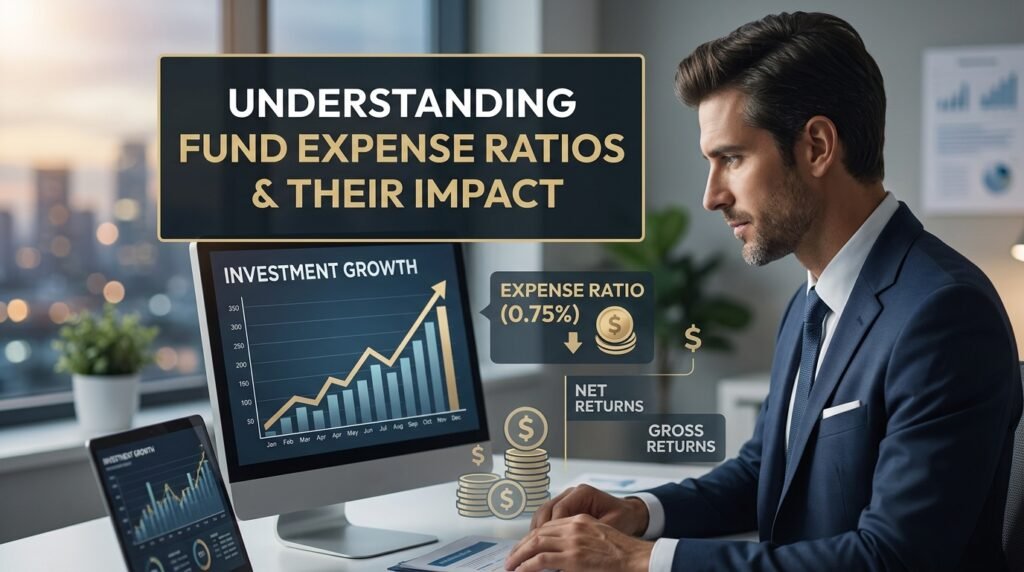
When you invest in mutual funds or exchange-traded funds (ETFs), the returns you earn are not the only factor that matters. Investment costs can also influence how much money you keep over time. One important cost to understand is the fund expense ratio.
A fund expense ratio represents the annual operating expenses charged by an investment fund as a percentage of its assets. Although the percentage may look small, these fees can gradually reduce your investment returns, particularly when you invest for many years.
Understanding fund expense ratios can help you compare investment options, control costs, and make more informed decisions about your long-term financial goals.
What Is a Fund Expense Ratio?
A fund expense ratio is the annual cost of operating an investment fund, expressed as a percentage of the fund’s assets under management.
These expenses may include portfolio management, administration, accounting, legal services, recordkeeping, and other operational costs. The exact expenses depend on the fund and its structure.
For example, suppose you invest $10,000 in a fund with an expense ratio of 0.50%. The annual expense would be approximately $50 if your investment balance remained at $10,000 throughout the year.
If another fund charges 0.10%, the equivalent annual expense on the same balance would be approximately $10.
The difference may seem small initially, but recurring fees can have a meaningful impact on long-term investment growth.
How Does a Fund Expense Ratio Work?
You generally do not receive a separate bill for a fund’s expense ratio. Instead, operating expenses are deducted from the fund’s assets over time.
As a result, the fund’s reported performance generally reflects these operating expenses. You do not usually need to subtract the stated expense ratio from the published return yourself.
For example, imagine a fund earns a 7% gross investment return during a year and has an expense ratio of 0.40%. Its return after fund operating expenses would be approximately 6.60%, assuming no other costs or adjustments.
Your personal return may differ because of taxes, brokerage charges, the timing of your investment, and changes in market prices.
It is also important to remember that an expense ratio is not a guaranteed fee measured against your original investment. Since it is calculated as a percentage of fund assets, the dollar amount can change as your balance rises or falls.
Why Does the Expense Ratio Matter?
The expense ratio matters because investment fees reduce the amount of money that remains invested and available to grow.
1. Lower Fees Can Support Higher Long-Term Returns
All else being equal, a fund with lower operating expenses allows investors to retain more of their investment returns.
Consider two funds that generate the same gross investment performance. If one charges 0.10% and the other charges 0.75%, the lower-cost fund has an advantage because less money is deducted for operating expenses.
However, a lower expense ratio does not guarantee better performance. Funds can hold different investments, follow different strategies, and experience different results.
2. Fees Can Reduce the Benefits of Compounding
Compounding occurs when investment earnings generate additional earnings over time. When fees reduce your investment balance, less money remains available to compound.
For example, imagine investing $10,000 for 20 years and earning an assumed annual return of 7% before fund expenses.
With a hypothetical annual expense ratio of 0.10%, the investment could grow to approximately $38,700. With an expense ratio of 0.75%, it could grow to approximately $34,500, assuming constant annual returns, annualized fees, and no additional contributions or withdrawals.
These figures are illustrations rather than predictions. Actual investment returns fluctuate, and fund expenses may be calculated and deducted differently throughout the year.
The example demonstrates why comparing fees can be useful when evaluating investments intended to be held for many years.
3. Fees Matter More When You Invest for Longer Periods
Investors saving for retirement or another long-term objective may hold funds for decades. During that period, recurring expenses can gradually affect the total value of their portfolios.
For investors with shorter time horizons, fees still matter, but the overall impact may be different depending on the investment amount, returns, and holding period.
The right approach is to consider both the cost of the fund and whether its investment strategy suits your financial goals.
What Is Considered a Good Expense Ratio?
There is no single expense ratio that is appropriate for every investment fund. Reasonable costs vary according to the fund’s investment strategy, asset class, management approach, and services.
Broad-market index funds often have relatively low expense ratios because they generally follow an established index instead of relying on extensive active security selection.
Actively managed funds may charge higher expenses because they involve additional research, investment decisions, and portfolio management.
Specialized funds, international funds, and certain alternative investment strategies can also have different cost structures.
Rather than judging a fund by its expense ratio alone, compare it with similar funds that pursue comparable objectives. Review the fund’s holdings, performance history, risks, and other costs before making a decision.
Expense Ratios in Index Funds and ETFs

Index funds and ETFs are popular investment choices, but their expense ratios can differ.
An index fund aims to track a specific market index. It may be structured as a mutual fund or an ETF. Many index funds use passive investment strategies, which can result in relatively low operating expenses.
An ETF is an investment fund that trades on a stock exchange. Some ETFs track market indexes, while others use active management or focus on specialized investment areas.
When comparing funds, look beyond the label. A fund that tracks a broad market index may have a different expense ratio from an ETF investing in a narrow industry or using a complex strategy.
ETFs may also involve bid-ask spreads and other trading costs. Traditional mutual funds may have minimum investment requirements or other charges. These expenses should be considered alongside the stated expense ratio.
How to Find a Fund’s Expense Ratio
Finding an expense ratio is generally straightforward.
Start by visiting the fund provider’s official website. Look for the fund’s overview, fees and expenses section, prospectus, or fact sheet.
You can also review the fund’s annual report or other official disclosure documents for additional information about its costs and investment structure.
When comparing funds, check the following details:
- Gross expense ratio: The fund’s operating expenses before applicable fee waivers or reimbursements.
- Net expense ratio: The expense ratio after applicable waivers or reimbursements.
- Waiver expiration: Whether a temporary fee reduction is scheduled to end.
- Other costs: Brokerage commissions, bid-ask spreads, sales charges, or account-related fees that may apply.
Make sure you compare equivalent figures. A temporary reduction in expenses may not represent the fund’s long-term cost.
How to Reduce Investment Costs
Investors can take several practical steps to manage fund expenses.
First, compare similar funds before investing. Two funds that track the same or a similar index may have different expense ratios.
Second, consider whether you need an actively managed fund or whether a simpler index-tracking strategy meets your objectives. Higher fees do not automatically mean better investment results.
Third, avoid choosing a fund based only on recent performance. Review its investment strategy, risk level, costs, and suitability for your time horizon.
Finally, consider your broader financial situation before committing money to investments. For example, understanding how higher interest rates affect savings and borrowing costs can help you evaluate other financial priorities alongside investing.
You may also want to separate money for planned expenses from long-term investments. Sinking funds can help you prepare for future purchases without needing to sell investments unexpectedly.
If you are balancing investments with outstanding debt, reviewing the difference between an emergency fund and paying off debt can help you organize your financial priorities.
Final Thoughts
A fund expense ratio is an important factor when choosing mutual funds and ETFs. It represents the annual operating costs deducted from a fund’s assets and can influence how much of your investment return you retain.
Even small differences in fees may affect long-term results because investment costs reduce the amount available for compounding. However, the lowest-cost fund is not automatically the right choice for every investor.
Compare expense ratios alongside investment objectives, diversification, risks, performance, and other costs. By understanding these factors, you can make more informed decisions and choose investments that support your long-term financial goals.