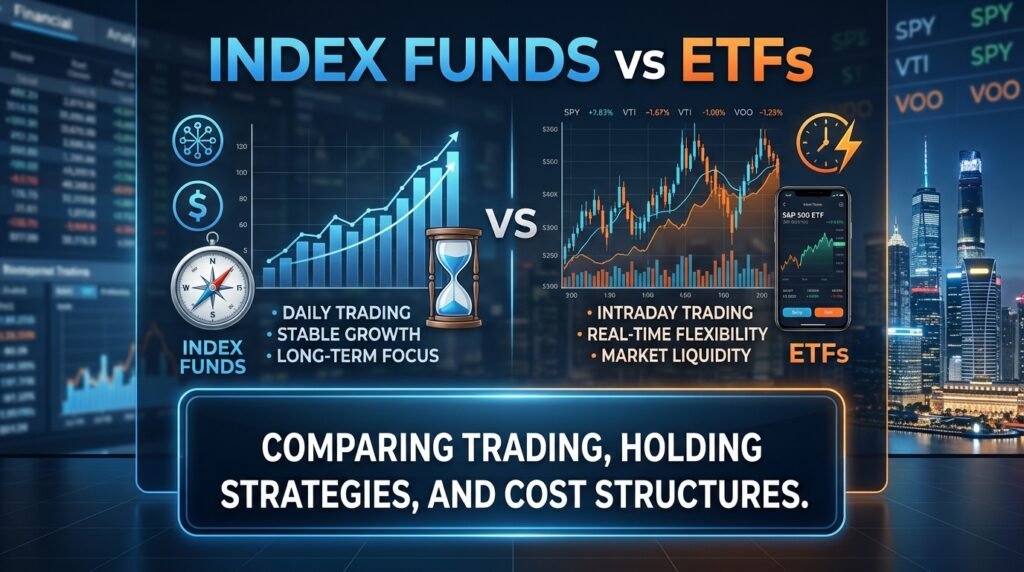
Choosing the right investment can feel confusing, especially when you encounter terms such as index funds and exchange-traded funds (ETFs). Both are popular investment options for people who want to build wealth over time without constantly buying and selling individual stocks. However, they work differently in several important ways.
Understanding index funds vs ETFs can help you compare investment costs, trading flexibility, taxes, and long-term investing strategies. The most important thing to know is that these two investment types are not necessarily opposites. An index fund describes an investment strategy, while an ETF describes a fund structure.
What Is an Index Fund?
An index fund is an investment fund designed to track the performance of a specific market index. An index measures the performance of a group of investments, such as stocks or bonds.
For example, an S&P 500 index fund aims to follow the performance of the S&P 500, an index representing approximately 500 leading publicly traded US companies.
Instead of trying to outperform the market through frequent trading, an index fund generally follows a passive investment strategy. It holds investments that represent the selected index, either by owning its securities directly or using another approach to track its performance.
Index funds can be structured as mutual funds or ETFs. Therefore, some ETFs are also index funds.
What Is an ETF?
An exchange-traded fund, commonly called an ETF, is an investment fund that trades on a stock exchange throughout the trading day.
ETFs can hold different types of investments, including stocks, bonds, commodities, or a combination of assets. Some ETFs follow market indexes, while others use actively managed investment strategies.
For example, an S&P 500 ETF may hold shares of companies included in that index. Investors can buy or sell shares through a brokerage account during regular market hours, just as they would trade individual stocks.
ETFs are popular because they offer investment diversification, trading flexibility, and access to different markets through a single investment.
Index Funds vs ETFs: Key Differences
Although index funds and ETFs can have similar investment goals, their structures and trading methods can differ.
1. Investment Strategy
An index fund follows a particular index, regardless of whether it is structured as a mutual fund or an ETF.
An ETF, on the other hand, does not necessarily track an index. It can follow an index, invest in a specific industry, hold bonds, or use an active investment strategy.
This distinction is important when comparing investment options. If you want passive investing, look for an index-tracking fund rather than assuming every ETF follows an index.
2. How You Buy and Sell
Traditional index mutual funds are generally purchased and redeemed through the fund provider or a brokerage platform. Transactions are typically processed at the fund’s net asset value calculated after the market closes.
ETFs trade on stock exchanges throughout the trading day. Their prices can change as buyers and sellers trade shares.
This means ETF investors may have more control over the price and timing of their trades. However, frequent trading can encourage unnecessary decisions that may not support a long-term investing strategy.
3. Minimum Investment Requirements
Some index mutual funds have minimum initial investment requirements. The amount depends on the fund provider and share class.
ETFs are generally purchased by the share, although some brokerages allow fractional-share investing. This can make it easier to begin investing with a relatively small amount of money.
Before investing, check the minimum investment requirements and whether your brokerage supports fractional shares.
4. Fees and Expenses
Both index funds and ETFs can have low expense ratios, but costs vary by provider and investment strategy.
The expense ratio represents the fund’s annual operating expenses as a percentage of assets. A lower expense ratio can help investors keep more of their returns over time, assuming other factors are similar.
ETFs may also involve brokerage commissions, bid-ask spreads, or other trading costs. Many brokers offer commission-free ETF trading, but investors should still understand the full cost of buying and selling.
Traditional index mutual funds may allow automatic investments without trading during the day. However, their minimum investment requirements and other fees can vary.
Comparing expense ratios alone is not always enough. Consider the overall cost of owning the investment.
5. Taxes and Tax Efficiency
ETFs can be more tax-efficient than many traditional mutual funds because of the way certain transactions are handled within the fund. However, tax outcomes depend on the fund’s structure, investment activity, account type, and local tax rules.
An ETF does not automatically eliminate taxes. Investors may still owe taxes on dividends, distributions, and capital gains when shares are sold in taxable accounts.
Index mutual funds can also be tax-efficient, particularly when they have low turnover. If you are investing outside a tax-advantaged retirement account, consider the potential tax consequences and seek professional advice when necessary.
Benefits of Index Funds
Index funds offer several advantages for long-term investors.
Diversification: A broad index fund can provide exposure to many companies or securities through a single investment.
Simplicity: Instead of researching individual stocks, investors can follow a defined market index.
Potentially low costs: Many index funds use passive strategies that can result in lower management expenses than actively managed alternatives.
Long-term focus: Index investing can help investors avoid frequent trading and focus on their broader financial goals.
However, index funds still carry market risk. If the underlying index declines, the fund’s value can also fall. Diversification does not guarantee profits or prevent losses.
Benefits of ETFs
ETFs offer their own advantages, particularly for investors who value flexibility.
Trading throughout the day: Investors can buy or sell ETF shares during market hours.
Broad investment choices: ETFs provide access to domestic and international stocks, bonds, sectors, and other asset classes.
Flexible investing amounts: Fractional shares, where available, can help investors start with smaller amounts.
Portfolio transparency: Many ETFs regularly disclose their holdings, allowing investors to review their investments.
Nevertheless, ETF prices can fluctuate during the trading day. Some specialized ETFs may also carry higher expenses, greater concentration risk, or more complicated investment strategies.
Index Funds vs ETFs: Which Is Better for Beginners?

Neither option is automatically better for every investor. The right choice depends on your financial goals, investing habits, fees, and preferred level of flexibility.
A traditional index mutual fund may suit someone who wants to invest a fixed amount regularly and prefers a simple process without monitoring intraday prices.
An index ETF may be more suitable for someone who wants exchange trading, flexible order types, or access to a wider range of investment choices.
For retirement investors, the bigger question is often whether the fund’s investments match their time horizon and risk tolerance. Reviewing longevity risk in retirement can help you consider how long your savings may need to support your future expenses.
You should also consider your wider financial position before investing. Maintaining money for unexpected expenses can reduce the need to sell investments during a market downturn. Learn more about preparing for major expenses without taking on debt.
How to Choose Between Index Funds and ETFs
Before choosing an investment, compare the fund’s objective, underlying holdings, expense ratio, minimum investment, and trading costs.
Check whether the fund tracks a broad market index or focuses on a particular industry or asset class. A narrow fund may provide less diversification than a broad-market option.
Think about how you plan to invest. If you prefer regular automatic contributions, check whether your brokerage supports them for the fund you choose. If you plan to trade during the day, understand how market prices and bid-ask spreads affect your transactions.
Finally, consider how the investment fits into your complete financial plan. Your investment choices should reflect your time horizon, emergency savings, retirement goals, and ability to tolerate losses. Understanding how an emergency fund compares with paying off debt can help you prioritize essential financial needs before committing money to market investments.
Final Thoughts
Index funds and ETFs can both help investors build diversified portfolios, but they describe different things. An index fund follows a market index, while an ETF is an investment structure that trades on an exchange. An ETF can be an index fund, but not every ETF tracks an index.
Compare investment goals, fees, trading methods, tax considerations, and risk before choosing a fund. Rather than focusing only on whether an investment is an index fund or an ETF, select an option that supports your long-term financial objectives and investing habits.