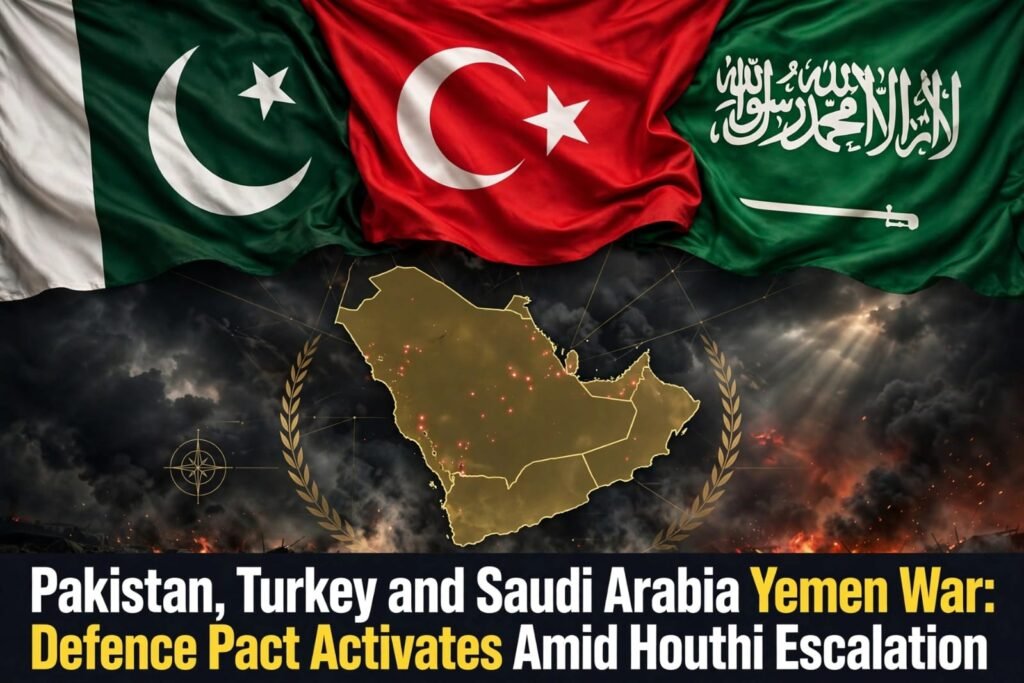
Pakistan, Turkey and Saudi Arabia Yemen War: Defence Pact Activates Amid Houthi Escalation
The Pakistan Turkey Saudi Arabia Yemen war situation has become a major regional story as fighting between Saudi-backed Yemeni government forces and the Iran-aligned Houthi movement intensifies. Saudi Arabia is supporting a military push against Houthi forces in Yemen, while Pakistan and Türkiye have agreed with Riyadh on practical steps to rapidly deploy agreed military forces and capabilities inside Saudi Arabia.
The development follows an emergency meeting of the Strategic-Political and Defence Committee of the Makkah Alliance for Defence in Riyadh on October 5, 2026. Pakistan, Saudi Arabia and Türkiye reviewed the growing security threats facing Saudi Arabia and agreed to move forward with the collective-defence commitments established under their Makkah Joint Defence Agreement.
The situation has created questions about whether Pakistan and Türkiye could become directly involved in the Yemen conflict. However, official Pakistani statements describe the Makkah agreement as defensive in nature. The agreement is designed to strengthen collective deterrence and defence rather than announce a new offensive against Yemen.
What Is Happening in Yemen?
Yemen has entered another serious phase of conflict after years of relative calm following the 2022 UN-brokered truce.
Saudi-backed Yemeni government forces have recently launched operations against Houthi fighters in strategically important areas. Reuters reported that Yemeni government forces moved to reclaim territory around the Bab el-Mandeb Strait and the coastal area leading toward Mocha.
The Bab el-Mandeb is one of the world’s most important maritime passages because it connects the Red Sea with the Gulf of Aden. Any prolonged fighting in the area can create concerns for international shipping, energy supplies and regional security.
The renewed fighting has therefore become much bigger than a local Yemeni battlefield.
Why Are Pakistan, Türkiye and Saudi Arabia Involved?
The Pakistan Turkey Saudi Arabia Yemen war discussion is closely connected to the Makkah Joint Defence Agreement.
Pakistan, Türkiye and Saudi Arabia signed the agreement in August 2026. Pakistan’s Foreign Ministry has repeatedly described the pact as defensive and said it is intended to strengthen collective deterrence, sovereignty and territorial security.
The three countries have since established mechanisms for cooperation under the agreement.
At the October 5 emergency meeting, officials approved measures to provide agreed military forces and capabilities and ensure their rapid deployment in Saudi Arabia, subject to the countries’ approved arrangements and national laws.
This means the immediate focus is on strengthening Saudi Arabia’s defensive capability.
Will Pakistan Fight the Houthis Directly?
This is one of the biggest questions surrounding the Pakistan Turkey Saudi Arabia Yemen war story.
At present, it would be inaccurate to say that Pakistan has officially announced a full-scale offensive role in Yemen.
Pakistan’s Foreign Office has described the Makkah Agreement as a defensive alliance. Earlier, the Foreign Office specifically said the agreement was not directed against any particular country and emphasized Pakistan’s support for dialogue and diplomacy in the region.
Recent reporting also indicates that Pakistan and Türkiye are providing military support and advisers while Saudi-backed Yemeni forces carry out operations against the Houthis. Reuters reported that the two countries were not expected to participate directly in combat under the current arrangement.
Therefore, the distinction between supporting Saudi Arabia’s defence and joining offensive operations inside Yemen is important.
Türkiye’s Role in the New Defence Arrangement
Türkiye is also an important member of the Makkah defence framework.
Turkish officials participated in the emergency Riyadh meeting alongside Pakistani and Saudi representatives. The meeting focused on the growing threats against Saudi Arabia and the practical implementation of collective-defence commitments.
Türkiye has its own military capabilities and a long-standing defence relationship with both Pakistan and Saudi Arabia.
The country’s involvement gives the new defence arrangement an additional military dimension, although the exact size and nature of any Turkish deployment will depend on the arrangements agreed by the three governments.
Saudi Arabia’s Military Campaign Against the Houthis
Saudi Arabia is already directly involved in the current escalation.
Saudi-backed Yemeni government forces have been fighting to regain strategic territory from the Houthis, particularly around the Bab el-Mandeb area.
Reuters reported that Saudi Arabia has supported these operations with airstrikes and other military assistance. The current campaign is aimed at pushing back Houthi forces and restoring control over strategically important areas.
The escalation follows Houthi attacks and threats against Saudi Arabia, according to Saudi and coalition statements.
Some of those accusations have been denied by the Houthis, making it important to distinguish confirmed military movements from claims made by opposing sides.
Why Is the Bab el-Mandeb Strait Important?
The Bab el-Mandeb Strait is a narrow waterway connecting the Red Sea with the Gulf of Aden.
It is a crucial route for international shipping because vessels travelling between Europe and Asia can use the Red Sea and Suez Canal to avoid longer routes around Africa.
Any disruption to the waterway can increase shipping costs and create delays.
That is why the renewed Yemen conflict has attracted international attention. Fighting near the strait could affect commercial shipping well beyond Yemen and Saudi Arabia.
The Pakistan Turkey Saudi Arabia Yemen war story therefore also has an important economic and maritime-security dimension.
What Is the Makkah Defence Agreement?
The Makkah Joint Defence Agreement was signed by Pakistan, Saudi Arabia and Türkiye in Makkah on August 7, 2026.
According to Pakistan’s Foreign Ministry, the agreement states that an armed attack against one of the three countries will be regarded as an attack against all, consistent with the right of individual and collective self-defence under the UN Charter.
The agreement is intended to strengthen cooperation in areas such as defence, deterrence, military capabilities and security.
The three countries have also been working to establish permanent institutional structures for the alliance.
Why Has the Pact Been Activated Now?
The latest developments in Yemen and attacks affecting Saudi Arabia have created the first major test for the new defence framework.
At the October 5 meeting, the three countries condemned attempted attacks targeting Makkah and Madinah and attacks against Saudi cities and civilian and economic infrastructure. They also reaffirmed their commitment to Saudi Arabia’s security and territorial integrity.
The committee then approved practical measures for rapidly deploying agreed military forces and capabilities in Saudi Arabia.
This is why the Pakistan Turkey Saudi Arabia Yemen war story has attracted so much attention internationally.
Pakistan’s Position on Yemen
Pakistan has repeatedly called for peace and stability in Yemen.
Its Foreign Ministry has said Pakistan supports the sovereignty and territorial integrity of Yemen and favors diplomatic efforts to resolve regional crises.
Pakistan has also emphasized its commitment to Saudi Arabia’s security under its defence partnership with Riyadh.
This creates a complicated position for Islamabad.
Pakistan has strong strategic relations with Saudi Arabia and Türkiye, but it also has an interest in avoiding a wider regional war.
The government’s public position therefore combines security cooperation with calls for diplomacy and de-escalation.
Could the Conflict Expand?
The possibility of a wider conflict is one of the major concerns.
If Houthi attacks against Saudi territory continue and Saudi-backed forces expand their military operations in Yemen, the situation could become more difficult to contain.
The involvement of additional regional powers could increase the military and political consequences.
However, the exact future role of Pakistan and Türkiye remains dependent on developments on the ground and decisions taken under the Makkah defence framework.
It would therefore be premature to describe the current situation as a three-country war against Yemen.
Iran’s Position
Iran is also an important part of the regional picture because the Houthis have long been described by international observers as Iran-aligned.
Recent reporting indicates that Iran has suggested political engagement with the Houthis as an alternative to continued escalation.
Pakistan’s Foreign Minister Ishaq Dar said the proposal would be discussed by the Makkah pact members. Reuters described the idea as a goodwill suggestion rather than a formal peace proposal.
This creates two competing paths: military pressure against the Houthis and diplomatic efforts to reduce tensions.
The outcome could significantly affect the wider Middle East.
Humanitarian Concerns
The renewed fighting is also creating humanitarian concerns inside Yemen.
Years of war have already left Yemen with serious problems involving poverty, food insecurity, healthcare and displacement.
The latest escalation risks creating additional displacement and worsening conditions for civilians.
Reports indicate that tens of thousands of people have been affected by the renewed fighting, while the wider conflict has already displaced large numbers of Yemenis.
Any expansion of military operations could make humanitarian assistance more difficult.
What Happens Next?
The next phase will depend on several factors.
First, Saudi Arabia and its partners will have to determine how the newly approved military deployments are implemented.
Second, Yemeni government forces will continue their efforts against the Houthis in strategically important areas.
Third, Pakistan and Türkiye will have to balance their commitments to Saudi Arabia with their stated preference for regional stability and diplomacy.
Finally, international efforts may focus on preventing the conflict from spreading further.
The situation is developing quickly, so military claims from the different sides should be treated carefully until independently confirmed.
A New Test for the Three-Country Alliance
The Pakistan Turkey Saudi Arabia Yemen war situation represents the first major security test for the newly created Makkah defence framework.
The three countries have publicly emphasized collective defence and regional stability.
At the same time, their governments must decide how far military cooperation should extend as the Yemen conflict develops.
For Pakistan in particular, the distinction between defending Saudi territory and participating in offensive operations in Yemen will remain important.
Türkiye faces a similar calculation as it expands its security relationship with Saudi Arabia.
The Pakistan Turkey Saudi Arabia Yemen war situation is developing amid a major escalation between Saudi-backed Yemeni government forces and the Houthis.
Saudi Arabia is directly supporting military operations in Yemen, while Pakistan and Türkiye have agreed to rapidly deploy agreed military forces and capabilities in Saudi Arabia under the Makkah defence framework.
However, the current evidence does not support describing the development simply as Pakistan and Türkiye declaring war on Yemen.
Pakistan’s government has repeatedly described the Makkah agreement as defensive and has continued to emphasize diplomacy and regional peace.
The biggest questions now concern the scale of military deployments, the future of the Saudi-backed offensive in Yemen, the response from the Houthis and whether diplomatic efforts can prevent the conflict from spreading.
With the Bab el-Mandeb Strait also involved, the consequences could extend beyond the Middle East and affect international shipping and regional security.
FAQs
1. Are Pakistan, Türkiye and Saudi Arabia going to war with Yemen?
Not officially in the sense of declaring war on Yemen. Saudi Arabia is supporting military operations against the Houthis, while Pakistan and Türkiye have agreed to strengthen Saudi Arabia’s defence under the Makkah agreement.
2. Will Pakistani troops fight the Houthis directly?
There has been no official announcement confirming that Pakistani forces will conduct direct offensive combat operations in Yemen.
3. What is the Makkah Joint Defence Agreement?
It is a defence agreement between Pakistan, Saudi Arabia and Türkiye designed to strengthen collective defence and deterrence.
4. Why are Pakistan and Türkiye deploying forces to Saudi Arabia?
The three countries have agreed to rapidly deploy agreed military forces and capabilities in Saudi Arabia amid security threats facing the kingdom.
5. Who are the Houthis?
The Houthis are an armed political and military movement based in Yemen that has controlled large parts of northern Yemen and has been involved in the country’s long-running conflict.
6. Why is Saudi Arabia fighting the Houthis?
The current escalation follows attacks and security threats involving Saudi Arabia, while Saudi-backed Yemeni forces are attempting to reclaim territory from the Houthis.
7. Is Pakistan supporting Saudi Arabia?
Yes. Pakistan has reaffirmed its commitment to Saudi Arabia’s security and is participating in the Makkah defence framework.
8. Is Türkiye also supporting Saudi Arabia?
Yes. Türkiye is a member of the Makkah defence agreement and participated in the emergency Riyadh meeting concerning Saudi security.
9. Why is the Bab el-Mandeb Strait important?
It is a strategically important maritime passage connecting the Red Sea with the Gulf of Aden and is vital for international shipping.
10. Could the Yemen conflict become a wider regional war?
The possibility of wider escalation is a concern, but the future course depends on military developments, regional decisions and diplomatic efforts.
US Troops Leave Iraq: Final Withdrawal Ends Major U.S. Military Mission