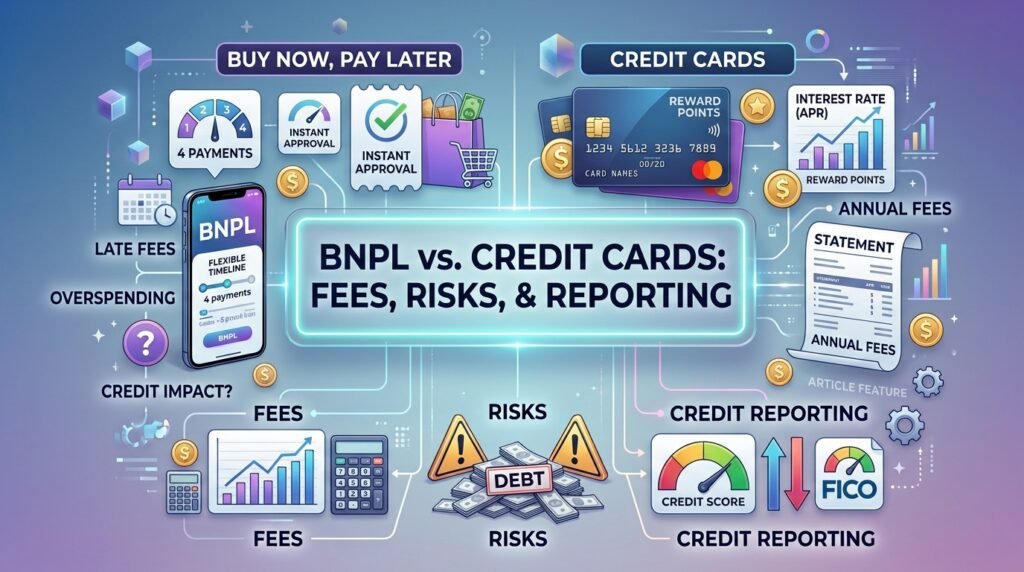
Buy now, pay later (BNPL) services and credit cards offer different ways to pay for purchases without paying the entire amount upfront. Both options can make shopping more flexible, but they also come with fees, repayment responsibilities, and potential credit-related consequences.
BNPL services usually divide a purchase into several scheduled installments, while credit cards provide a revolving credit line that can be reused as you repay the balance. Understanding these differences can help you manage spending, compare costs, and avoid unexpected financial problems.
What Is Buy Now, Pay Later?
Buy now, pay later is a payment option that allows consumers to purchase products immediately and pay for them over time. It is commonly offered during online checkout and sometimes in physical stores.
A typical short-term BNPL plan divides a purchase into four payments. The customer may pay the first installment at checkout and the remaining installments over the following weeks.
Many short-term plans advertise no interest when payments are made according to the agreement. However, longer financing plans may charge interest, and some providers may charge late fees or other costs.
The exact terms depend on the provider, purchase, country, and repayment plan.
How Do Credit Cards Work?
A credit card gives you access to a revolving credit limit. You can use the card for purchases and repay the amount borrowed according to your monthly statement.
If you pay your statement balance in full by the due date, you can generally avoid interest on eligible purchases when your card offers a grace period and you meet its requirements.
However, if you carry a balance, interest may accumulate according to your card’s annual percentage rate (APR).
Credit cards can also charge annual fees, foreign transaction fees, balance transfer fees, cash advance fees, and late payment fees, depending on the agreement.
Unlike many short-term BNPL plans, credit cards usually allow you to continue making purchases as available credit is restored through repayments.
Buy Now, Pay Later vs Credit Cards: Key Differences
Although both payment methods allow you to delay paying for a purchase, their structures differ.
Repayment schedule: BNPL plans generally have fixed installment dates. Credit cards usually have monthly billing cycles and a minimum payment requirement.
Interest: Some BNPL plans are interest-free when paid on time, while credit cards can charge interest when eligible balances are not repaid in full.
Credit limits: BNPL providers may approve individual purchases or assign spending limits. Credit cards generally provide a reusable credit limit.
Credit reporting: Reporting practices vary among BNPL providers, credit bureaus, credit card issuers, and countries.
Spending flexibility: Credit cards can be used repeatedly at many merchants, while BNPL may be available only through participating providers and merchants.
The right comparison depends on the specific terms of each option rather than the payment method alone.
Fees and Hidden Costs to Consider
Fees can change the actual cost of a purchase, even when the advertised payment initially looks affordable.
Buy Now, Pay Later Fees
Depending on the provider and plan, potential BNPL costs may include:
- Late payment fees
- Interest on longer-term financing
- Bank overdraft fees if an automatic payment causes insufficient funds
- Other charges disclosed in the agreement
Some providers do not charge late fees, while others may apply them under specific circumstances. Always review the payment schedule and fee policy before accepting a plan.
Credit Card Fees
Credit cards may involve several different charges, including:
- Interest on carried balances
- Annual membership fees
- Late payment fees
- Cash advance fees
- Balance transfer fees
- Foreign transaction fees
For example, a credit card purchase may be interest-free if the statement balance is paid in full under the card’s terms. If the balance is carried forward, interest can make the original purchase more expensive.
When comparing payment options, calculate the total amount you will pay rather than focusing only on the size of each installment.
A Simple Cost Comparison
Imagine you want to purchase a laptop priced at $800.
With a four-payment BNPL plan, you might pay $200 at checkout and another three payments of $200 according to the schedule. If the plan has no interest or fees and every payment is made on time, the total would remain $800.
Now imagine using a credit card with an $800 purchase balance.
If you pay the eligible statement balance in full by the due date and qualify for the grace period, you may avoid purchase interest. However, if you carry the balance, interest may be added according to your APR and payment activity.
In this example, both methods could have the same purchase cost under certain conditions. The difference appears when fees, interest, repayment timing, or missed payments enter the picture.
These figures are illustrative. Actual costs depend on the agreements and applicable terms.
How BNPL Can Affect Your Credit Report
BNPL credit reporting is not identical across all providers or countries.
Some providers may perform a soft credit inquiry during the application process, while others may use different checks depending on the plan. Certain providers report account activity or repayment information to credit bureaus, while others may report only particular products or events.
Missed payments may also have consequences beyond a credit score. Depending on the provider and applicable rules, unpaid balances could lead to collection activity.
Before using a BNPL service, check whether it reports payments, whether it performs a credit inquiry, and what happens if you miss an installment.
Do not assume that a plan has no credit impact simply because it is advertised as interest-free.
How Credit Cards Affect Your Credit Score

Credit cards can influence your credit profile through payment history, credit utilization, account age, and credit inquiries.
Making payments on time can help maintain a positive payment history. On the other hand, missed payments can harm your credit profile if they are reported according to applicable rules.
Credit utilization is another important factor. It measures the amount of revolving credit you use relative to the credit available to you.
For example, if your credit limit is $5,000 and your balance is $2,500, your utilization is 50%.
A high balance can affect your credit profile, depending on the scoring model. Paying down your balance may reduce utilization, although the timing of reported balances can vary.
What Happens If You Miss a Payment?
Missing payments can create financial problems with either payment method.
With BNPL, a missed installment may result in a late fee, restrictions on future purchases, collection activity, or credit reporting consequences, depending on the agreement.
With a credit card, missing the required minimum payment may result in late fees, interest charges, and possible credit reporting consequences. The impact depends on how late the payment becomes and the applicable reporting rules.
If you are already managing several payments, it can help to understand how credit card issuers apply the money you send. Our guide to credit card payment allocation and which balance gets paid first explains how payments may be distributed among different balances.
Keeping track of due dates and maintaining enough money in your bank account can help reduce the risk of missed payments.
The Risk of Taking on Too Many Payments
One major risk with BNPL is that several individually small installments can become difficult to manage when they overlap.
For example, you might have one installment for clothing, another for electronics, and another for a household purchase. Each payment may look affordable by itself, but their combined cost could place pressure on your budget.
Credit cards can create a similar problem when you continue making purchases while carrying an existing balance.
Before accepting a new payment obligation, calculate your total upcoming payments and compare them with your expected income and essential expenses.
Avoid relying on future income that is uncertain or already needed for rent, utilities, food, transportation, and other important bills.
Can BNPL Help Build Credit?
Some BNPL products may report repayment information to credit bureaus, but reporting practices vary. As a result, using BNPL does not automatically build a positive credit history.
Credit cards generally have more established credit-reporting practices, although the exact treatment depends on the issuer, bureau, country, and account status.
If building credit is one of your goals, review the provider’s reporting policy before choosing a payment product. Also remember that a credit-building strategy should not require taking on purchases you cannot comfortably repay.
When Should You Consider BNPL or a Credit Card?
BNPL may suit a planned purchase when the repayment schedule is clear, the total cost is affordable, and you can make every installment on time.
A credit card may suit regular spending when you manage the balance carefully, understand the fees, and can repay eligible purchases in full.
Neither option is automatically cheaper or safer in every situation. The outcome depends on your spending habits, repayment capacity, and the specific terms offered.
If you are already carrying a credit card balance, review the interest rate and repayment plan before adding more debt. You can also read our guide on how a late credit card payment can affect your credit to understand some of the potential consequences of missed payments.
For another perspective on installment-based borrowing, our comparison of buy now, pay later vs personal loans explains how repayment periods, interest, and fees can differ across financing options.
Common Mistakes to Avoid
Focusing Only on the Installment Amount
A small payment does not necessarily mean a purchase is affordable. Consider the total price, all scheduled payments, and any potential fees.
Ignoring Multiple Payment Due Dates
Several installment plans can overlap. Keep a clear record of the amount and date of every payment.
Assuming BNPL Never Affects Credit
Credit checks and reporting policies vary. Read the provider’s terms instead of assuming there will be no credit impact.
Carrying Credit Card Debt Without a Plan
If you cannot repay your credit card balance in full, estimate how interest and payments will affect the total cost over time.
Borrowing for Unnecessary Purchases
Payment flexibility does not increase your income. Consider whether a purchase fits your budget before choosing how to pay for it.
Final Thoughts
Buy now, pay later and credit cards both offer ways to delay payment, but they operate differently. BNPL commonly uses scheduled installments, while credit cards provide revolving credit with monthly statements and potentially ongoing interest.
The total cost, fees, credit reporting practices, and consequences of missed payments depend on the specific product and agreement.
Before choosing either option, review the complete repayment terms, calculate the total cost, and make sure the payments fit your budget. Using a payment method responsibly starts with understanding what you owe and when you must pay it.