
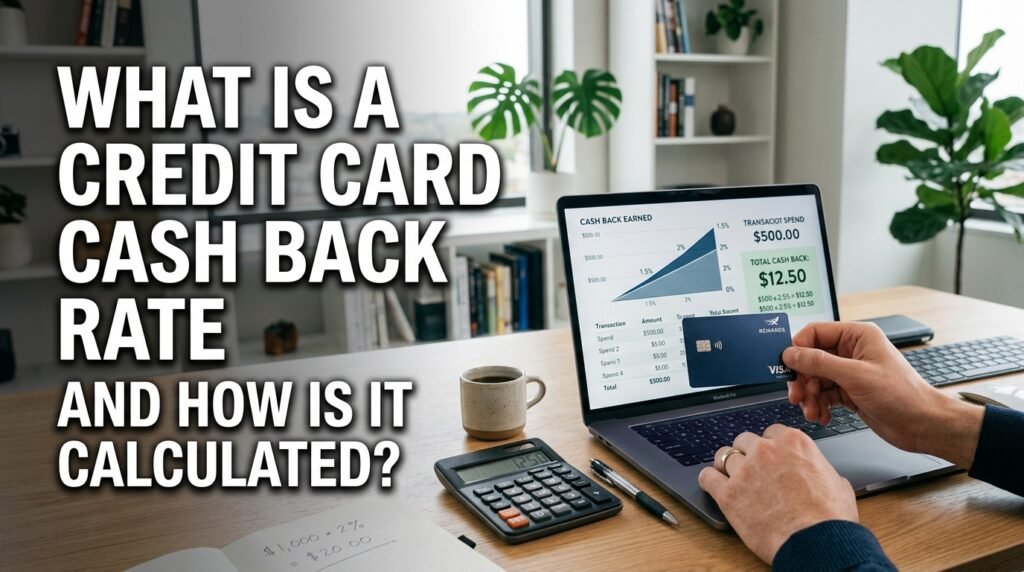
A credit card cash back rate tells you how much of your eligible spending you can receive back as a reward. For example, a card offering 2% cash back generally gives you $2 in rewards for every $100 in eligible purchases.
Cash back credit cards can make everyday spending more rewarding, but the advertised percentage does not always tell the whole story. Different cards may offer different rates for different spending categories, place limits on rewards, or require specific conditions before you receive them.
Understanding how cash back works can help you compare credit cards and estimate how much you could realistically earn from your normal spending.
What Is a Credit Card Cash Back Rate?
A credit card cash back rate is the percentage of eligible purchases returned to you as a reward.
For example, suppose your credit card offers a flat 2% cash back rate. If you spend $500 on eligible purchases, your potential cash back would be:
$500 × 2% = $10
If you spend $2,000 during a month at the same rate, you could earn:
$2,000 × 2% = $40
The actual rewards you receive depend on the card’s terms, eligible purchases, exclusions, spending limits, and other conditions.
Some credit cards offer the same cash back rate on most purchases, while others provide higher rates for selected categories.
How Is Cash Back Calculated?
The basic cash back calculation is relatively simple:
Cash Back = Eligible Spending × Cash Back Rate
Suppose you use a card that offers 3% cash back on groceries and spend $600 on eligible grocery purchases during a month.
The calculation would be:
$600 × 3% = $18
You would potentially earn $18 in cash back from that spending.
Now imagine you spend another $900 on purchases that earn 1% cash back:
$900 × 1% = $9
Your total cash back for those purchases would be $27.
This example shows why your spending habits matter. A card with a high advertised rate may not necessarily generate more rewards if you rarely spend in its bonus categories.
Flat-Rate vs. Category-Based Cash Back
Cash back cards generally use different reward structures.
Flat-Rate Cash Back
A flat-rate card provides the same cash back percentage on eligible purchases.
For example, a card might offer 2% cash back on eligible purchases regardless of whether you use it for groceries, gas, dining, or other everyday expenses.
The main advantage of this structure is simplicity. You do not have to remember which categories earn higher rewards.
Category-Based Cash Back
Category-based cards offer different cash back rates depending on the type of purchase.
For example, a hypothetical card could offer:
- 3% on groceries
- 3% on dining
- 2% on gas
- 1% on other eligible purchases
If your spending is concentrated in those higher-rate categories, the structure may produce more rewards than a flat-rate card.
However, category restrictions and spending limits can affect the actual rewards you receive.
Before choosing a card, it can help to review how to choose the right credit card for your spending habits based on where you normally spend money.
How to Calculate Your Annual Cash Back
To estimate your annual cash back, start by calculating your spending in each reward category.
Suppose your hypothetical annual spending looks like this:
- $8,000 on groceries at 3%
- $4,000 on dining at 3%
- $5,000 on other purchases at 1%
Your estimated rewards would be:
$8,000 × 3% = $240
$4,000 × 3% = $120
$5,000 × 1% = $50
Total annual cash back:
$240 + $120 + $50 = $410
This is a simple illustration. Actual rewards depend on the card’s terms and whether each purchase qualifies for the advertised rate.
Do Cash Back Cards Have Spending Limits?
Some cash back cards may place limits on how much spending qualifies for an elevated reward rate.
For example, a hypothetical card could offer 5% cash back on the first $1,500 spent in a particular category during a specified period and then provide a lower rate after that threshold.
If you spend beyond the qualifying limit, the additional purchases may earn rewards at a different rate.
This is why you should look beyond the headline percentage when comparing cards. Check the reward cap, eligible categories, qualifying period, and rate that applies after the limit is reached.
What Purchases May Not Earn Cash Back?
Not every transaction necessarily earns cash back.
Depending on the card, certain transactions may be excluded from rewards. Examples can include fees, interest charges, cash advances, balance transfers, or other transactions defined in the card agreement.
Cash back is generally tied to eligible purchases rather than simply every dollar that appears on your account.
For this reason, read the rewards terms carefully before assuming a particular transaction will earn rewards.
Does Carrying a Balance Affect Cash Back Value?

Yes. This is one of the most important points to understand.
Suppose you earn $20 in cash back during a billing period but carry a credit card balance that results in significant interest charges. The interest you pay can easily outweigh the value of the rewards.
Cash back does not cancel interest charges.
A card with a 3% reward rate does not mean you are effectively borrowing money at 3%. Your purchase APR and cash back rate are separate parts of the account.
If you are considering a promotional offer, you should also understand how credit card promotional APR works, including how long the promotional period lasts and what APR may apply afterward.
Does Cash Back Affect Your Credit Score?
The cash back reward itself does not generally determine your credit score.
However, the way you use the credit card can affect your credit profile.
For example, making payments on time can support a positive payment history, while carrying a high balance relative to your credit limit can affect your reported credit utilization.
Your statement timing can also matter because card issuers may report account information to credit reporting companies during their regular reporting cycle. You can learn more about how your statement date can affect reported credit utilization.
Cash back should therefore be viewed as a reward feature, not a method for improving your credit score by itself.
Are Higher Cash Back Rates Always Better?
Not necessarily.
A card offering 5% cash back in one category may sound better than a card offering 2% on everything. But the 5% card may have spending limits or restrictive categories.
Consider a simple example.
Suppose you spend $300 per month in a 5% category:
$300 × 5% = $15
That produces $180 in annual rewards if the rate applies throughout the year.
Now suppose you spend $2,000 per month across different categories on a flat 2% card:
$2,000 × 2% = $40 per month
That would equal $480 annually.
The better fit depends on your actual spending pattern, not simply the largest percentage shown in an advertisement.
What About Annual Fees?
An annual fee can reduce the real value of cash back.
Suppose you earn $300 in cash back during a year but pay a $95 annual fee. Your rewards after the annual fee would be:
$300 – $95 = $205
This does not necessarily mean the card is unsuitable. Other benefits may have value, and some cards offer additional rewards or perks.
However, when comparing cash back cards, consider the net value after applicable fees rather than looking only at the advertised reward rate.
How to Maximize Cash Back Responsibly
A few simple habits can help you make better use of a cash back card.
First, choose a card that matches your normal spending. Do not spend extra money simply to earn rewards.
Second, understand the reward categories and spending limits.
Third, check whether the card has an annual fee and compare that cost with your expected rewards.
Fourth, review the redemption rules. Some cards may allow cash back as a statement credit, direct deposit, check, or another redemption method.
Finally, avoid carrying a costly balance simply to earn rewards. Paying interest can reduce or eliminate the financial value of your cash back.
Frequently Asked Questions
What does a 2% cash back rate mean?
A 2% cash back rate generally means you can earn $2 in rewards for every $100 of eligible spending, subject to the card’s terms.
How do I calculate 3% cash back?
Multiply your eligible spending by 0.03. For example, $1,000 in eligible spending at 3% would produce $30 in cash back.
Is cash back free money?
Cash back is a reward associated with eligible credit card spending, but it does not eliminate interest, fees, or debt. Spending more than you otherwise would just to earn rewards can reduce their value.
Do all credit cards offer cash back?
No. Cash back is a feature offered by certain rewards credit cards. Other cards may provide points, miles, introductory offers, or no rewards.
Can cash back expire?
Cash back rules vary by card issuer. Some rewards may have expiration conditions or could be affected by account closure or other circumstances. Check your card’s rewards agreement for the applicable rules.
Final Thoughts
A credit card cash back rate represents the percentage of eligible spending you can receive back as a reward. Calculating it is usually straightforward: multiply eligible spending by the applicable cash back percentage.
However, the advertised rate is only one part of the equation. Category restrictions, reward limits, annual fees, redemption rules, and interest charges can all affect the real value of a cash back card.
The best way to evaluate a cash back card is to compare its rewards structure with your actual spending habits and consider the overall cost of the account. When used responsibly and paid according to the card’s terms, cash back can provide useful rewards on purchases you were already planning to make.