
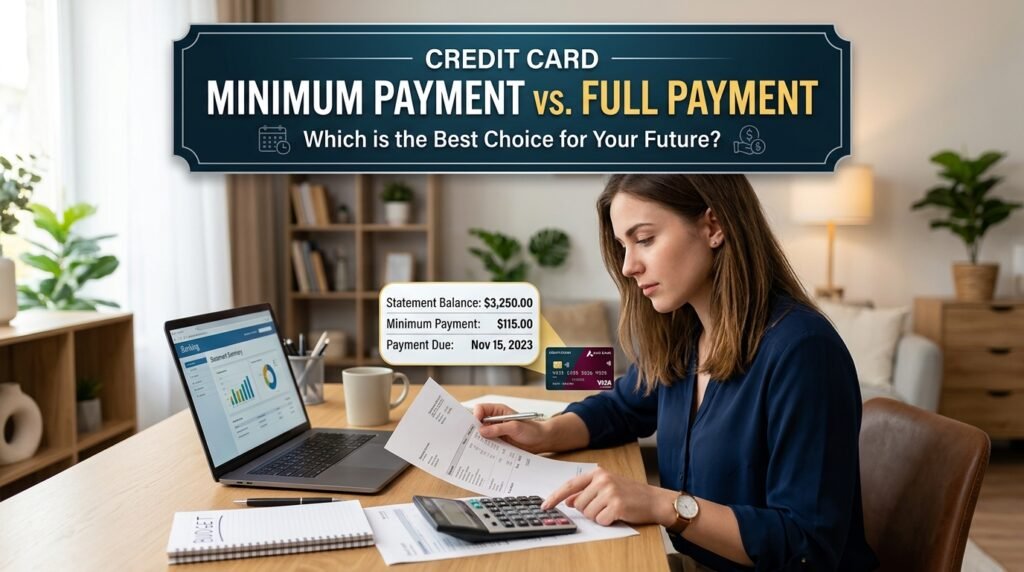
When you receive a credit card statement, you may see two important payment amounts: the minimum payment and the full statement balance. Understanding the difference between these two options can help you manage credit card debt, avoid unnecessary interest charges, and maintain better control over your finances.
Paying the minimum can keep your account current, but it may allow interest to continue accumulating on the remaining balance. Paying the full statement balance, when possible, can help you avoid interest on purchases when your card’s terms provide a grace period.
Knowing how each payment option works can make it easier to choose a payment strategy that fits your budget.
What Is a Credit Card Minimum Payment?
The minimum payment is the smallest amount your credit card issuer requires you to pay by the due date to keep your account in good standing.
The exact calculation varies by card issuer. It may be based on a percentage of your balance, a fixed minimum amount, interest and fees, or a combination of these factors.
For example, imagine your credit card statement shows:
- Statement balance: $2,500
- Minimum payment: $75
- Payment due date: August 25
If you pay $75 by the due date, you have met the minimum payment requirement for that billing cycle. However, the remaining balance may continue to accrue interest according to the terms of your credit card.
The minimum payment is therefore not the same as the amount you need to pay to avoid interest.
What Is a Full Credit Card Payment?
A full payment generally means paying the entire statement balance shown on your credit card statement by the due date.
For example, if your statement balance is $2,500 and the minimum payment is $75, paying the full $2,500 by the due date means you have paid the statement balance in full.
For many credit cards, paying the statement balance in full by the due date can help you avoid interest on eligible purchases if your account has a grace period and you are not already carrying a revolving balance.
Your card agreement determines exactly how interest and grace periods work, so it is important to review the terms of your specific card.
Minimum Payment vs. Full Payment

The main difference is what happens to the remaining balance after your payment.
With a minimum payment, you pay only the required amount and carry the remaining balance into the next billing cycle. Interest may then be charged on that balance.
With a full payment, you pay the entire statement balance. When the card’s grace-period terms apply, this can allow you to avoid interest on eligible purchases.
Consider a simple example:
- Statement balance: $2,000
- Minimum payment: $60
- Full payment: $2,000
If you pay $60, approximately $1,940 remains before considering new charges and interest. If you pay $2,000, the statement balance is cleared.
The difference may seem small when looking only at the payment due today, but it can become significant over several months.
Why Paying Only the Minimum Can Cost More
Credit card interest can make a minimum-payment strategy expensive over time.
When you make only the minimum payment, a smaller portion of your payment may go toward reducing the principal balance after interest and applicable fees are accounted for. If you continue making new purchases, the balance can take even longer to pay down.
For example, suppose you have a $3,000 balance and make relatively small payments while continuing to use the card. The balance may decline slowly, while interest continues to accumulate.
Your credit card statement may provide information showing how long it could take to repay the balance if you make only minimum payments. Reviewing this information can help you understand the potential long-term cost.
If you want to understand how credit card balances relate to your available credit, you can also read our guide to credit utilization, which explains how the amount you owe compares with your available credit.
Benefits of Paying the Full Statement Balance
Paying the full statement balance has several potential benefits.
You May Avoid Interest on Eligible Purchases
When your credit card offers a grace period and you meet its requirements, paying the statement balance in full by the due date can help you avoid interest on purchases.
This can make credit cards less expensive when they are used responsibly.
You Can Reduce Credit Card Debt
Paying the full statement balance prevents the balance from rolling over from one billing cycle to another.
If you consistently pay the full amount and avoid spending more than you can afford, you can reduce the risk of building revolving debt.
It Can Make Budgeting Easier
Paying your balance in full requires you to account for your credit card spending within your monthly budget.
A realistic budget can help you determine how much you can afford to spend on a credit card without creating a balance that becomes difficult to repay. Our guide on how to create a monthly budget explains how to organize income, expenses, savings, and debt payments.
When Paying Only the Minimum May Be Necessary
Paying the full balance is not always possible.
An unexpected expense, temporary loss of income, or other financial emergency can make it difficult to pay everything at once. In such situations, making at least the minimum payment by the due date can help you keep the account current while you work on a repayment plan.
However, paying only the minimum should generally be viewed as a short-term response rather than a permanent strategy if it causes expensive revolving debt to accumulate.
If you are carrying credit card debt, consider reviewing your budget, reducing unnecessary expenses, and directing additional money toward the balance when possible.
Does Paying the Minimum Hurt Your Credit Score?
Making the required minimum payment on time is generally better for your payment history than missing the payment.
However, making only minimum payments does not automatically mean your credit score will improve. If a balance remains high relative to your credit limit, your credit utilization may also be high.
Credit utilization is one factor considered by many credit scoring models. Your payment history, length of credit history, credit mix, and recent credit applications can also matter.
This means paying on time is important, but it is not the only part of responsible credit management.
What Happens If You Miss the Minimum Payment?
Missing the minimum payment can have more serious consequences than simply paying less than the full balance.
Depending on your card agreement and how late the payment becomes, you may face:
- A late payment fee
- Additional interest or other charges
- A potential penalty APR under applicable terms
- Negative information reported to credit bureaus if the account becomes sufficiently delinquent
The exact consequences depend on the card issuer, account agreement, and applicable rules.
One of the easiest ways to reduce the risk of missing a payment is to set up automatic payments for at least the minimum amount, while making additional payments manually when possible.
How to Decide Between Minimum and Full Payment
Your financial situation should determine your payment strategy.
Choose the Full Statement Balance When You Can Afford It
If your budget allows you to pay the entire statement balance without using savings needed for essential expenses, paying in full can help you avoid revolving credit card debt and potentially avoid interest on eligible purchases.
Pay More Than the Minimum When Full Payment Is Not Possible
If you cannot pay the entire balance, paying more than the minimum can reduce the balance faster and may reduce the amount of interest you pay over time.
For example, if your minimum is $60 but your budget allows you to pay $150, the additional $90 can help reduce the outstanding balance faster.
Always Make at Least the Minimum by the Due Date
If money is tight, prioritize making at least the required minimum payment by the due date.
Then review your budget to determine whether you can make an additional payment later in the month.
Credit Card Payments and Your Monthly Budget
Your credit card payment should be included in your overall monthly financial plan rather than treated as an expense separate from your normal spending.
For example, if your take-home income is $4,000 and your essential expenses already consume $3,300, you have limited room for discretionary credit card spending.
Using a credit card for purchases without considering how those purchases will be repaid can create a gap between your current spending and future income.
A monthly budget can help you identify how much money is available for debt repayment after essential expenses and savings goals.
Minimum Payment vs. Full Payment: A Simple Example
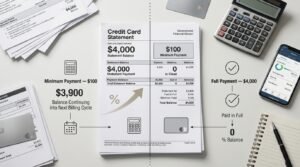
Imagine you have a $4,000 credit card balance and your issuer requires a $100 minimum payment.
You have two basic options.
With the first option, you pay only $100. The remaining balance continues into the next billing cycle, and interest may be charged according to your card’s terms.
With the second option, you pay the full $4,000 statement balance. If your grace-period requirements are satisfied, eligible purchases may avoid interest.
The exact financial difference depends on your APR, balance, payment timing, fees, and future purchases.
The important point is that the minimum payment is designed to keep the account current, while paying the full statement balance can help prevent revolving debt from continuing.
What If You Have Multiple Credit Cards?
If you have balances on several credit cards, start by making at least the minimum payment on every account.
After that, you can direct extra money toward a selected balance. Some people prioritize the card with the highest APR because reducing high-interest debt can reduce interest costs. Others prefer paying the smallest balance first to create quicker milestones.
Your choice should fit your budget and repayment goals.
If you are also considering other forms of borrowing, understanding the total cost of loans is important. Our guide on how to calculate the true cost of a personal loan explains how interest, fees, loan terms, and other costs can affect the amount you ultimately pay.
Common Credit Card Payment Mistakes
Several mistakes can make credit card debt more difficult to manage.
Treating the Minimum as a Recommended Payment
The minimum payment is the amount required under your card’s terms, not necessarily the amount that minimizes your interest costs.
Continuing to Spend While Carrying a Balance
New purchases can increase your balance and make repayment more difficult.
Ignoring the APR
A high APR can make carrying a balance expensive. Check your card agreement and statement so you understand the rate that applies to your balance.
Missing the Due Date
Even if you cannot pay the full balance, missing the minimum payment can create avoidable fees and other consequences.
Using Credit to Cover an Unsustainable Budget
If you regularly need a credit card to cover basic monthly expenses, it may be a sign that your budget needs to be reviewed.
Final Thoughts
The difference between a credit card minimum payment and a full payment is more than the amount shown on your monthly statement.
A minimum payment can help keep your account current, but carrying the remaining balance may lead to ongoing interest charges. Paying the full statement balance, when financially possible and when your card’s grace-period terms apply, can help you avoid interest on eligible purchases and keep revolving debt under control.
If paying the full balance is not possible, focus on making at least the minimum payment on time and then paying as much extra as your budget allows. The goal is to manage your credit card in a way that supports your overall financial plan rather than creating debt that becomes difficult to repay.
Frequently Asked Questions
Is it better to pay the minimum payment or the full balance?
If you can comfortably afford it, paying the full statement balance can help you avoid interest on eligible purchases when your card’s grace-period terms apply. If you cannot pay in full, make at least the minimum payment by the due date and consider paying more when possible.
Does paying the full credit card balance improve your credit score?
Paying the full balance can help keep your credit utilization lower, but it does not guarantee a higher credit score. Credit scores consider multiple factors.
Can I pay more than the minimum payment?
Yes. You can generally pay more than the required minimum. Paying additional amounts can reduce your balance faster and may reduce interest costs.
What happens if I only pay the minimum every month?
The remaining balance can continue into future billing cycles, and interest may accumulate according to your card’s terms. Repayment can take much longer than if you make larger payments.
Do I have to pay my credit card balance in full every month?
No. You are generally required to make at least the minimum payment by the due date. However, paying the statement balance in full can help avoid interest on eligible purchases when the card’s grace-period conditions are met.
Does paying the minimum keep my credit card in good standing?
Making at least the required minimum payment by the due date generally helps keep the account current. However, carrying a high balance can still have financial and potential credit-score consequences.