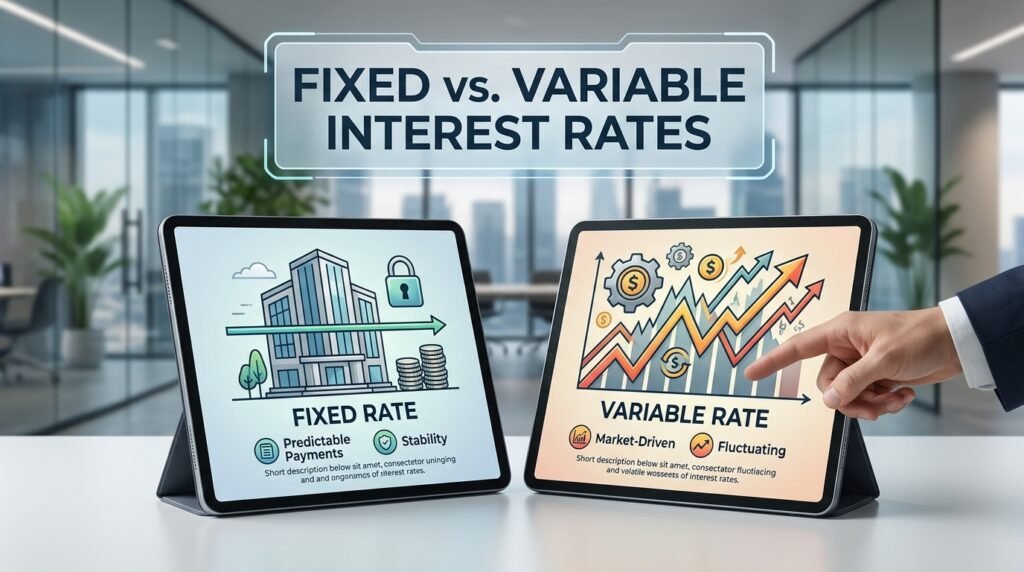
When you borrow money, the interest rate can have a significant effect on how much you ultimately pay. Two common types of interest rates are fixed and variable rates. Understanding the difference between fixed vs. variable interest rates can help you evaluate loan offers and choose a borrowing structure that fits your financial situation.
A fixed interest rate generally stays the same throughout the agreed loan period. A variable interest rate, on the other hand, can change over time based on the terms of the loan and the benchmark or index used by the lender.
Both options have potential advantages and disadvantages. The right choice depends on the type of loan, your financial situation, your ability to handle changing payments, and the terms offered by the lender.
What Is a Fixed Interest Rate?
A fixed interest rate remains unchanged for the period specified in the loan agreement. If you take a loan with a fixed rate, the interest rate does not normally change simply because market interest rates move.
For example, if a personal loan has a fixed interest rate, your scheduled principal and interest payments may remain predictable throughout the repayment period, assuming there are no changes caused by other loan terms or fees.
This predictability can make budgeting easier because you have a clearer idea of how much you need to allocate toward the loan each month.
Fixed rates are commonly associated with loans where borrowers want greater payment stability.
What Is a Variable Interest Rate?
A variable interest rate can change over time. The rate may be tied to an underlying benchmark or index, with the loan agreement explaining how and when adjustments can occur.
When the applicable rate increases, the borrower’s interest costs may increase as well. If the rate decreases, borrowing costs may potentially decrease.
The exact effect depends on the loan structure. Some variable-rate loans may have limits on how much the rate can change during a specific period, while others may have different adjustment rules.
Before accepting a variable-rate loan, borrowers should understand what determines the rate and how frequently it can change.
Fixed vs. Variable Interest Rates
The biggest difference between fixed and variable interest rates is how the rate behaves over time.
With a fixed rate, the interest rate is generally locked in for the agreed period. With a variable rate, the interest rate can change according to the terms of the loan.
A fixed rate provides greater payment predictability, while a variable rate can expose borrowers to changing borrowing costs.
Neither structure is automatically suitable for every borrower. Comparing the complete loan terms is important because the interest rate is only one part of the overall cost.
How Fixed Interest Rates Affect Your Payments
One of the main advantages of a fixed rate is predictability.
If the loan has a fixed interest rate and a standard fixed-payment structure, borrowers can generally plan around a consistent scheduled payment. This can make it easier to organize monthly expenses and maintain a budget.
For borrowers who prefer financial stability, knowing that the interest rate will not change can reduce uncertainty.
However, fixed-rate loans may sometimes begin with a higher rate than certain variable-rate alternatives. The actual difference depends on the lender, loan type, borrower qualifications, and market conditions.
Before taking on a new loan, it is also important to understand the complete borrowing cost.
How Variable Interest Rates Affect Your Payments

Variable rates introduce more uncertainty because the interest rate can change.
If market conditions cause the applicable rate to increase, your borrowing costs can rise. Depending on the loan structure, your monthly payment could increase, the repayment period could change, or a larger portion of your payment could go toward interest.
On the other hand, if the applicable rate decreases, you may benefit from lower interest costs depending on the terms of the loan.
Because future rates cannot be known with certainty, borrowers considering a variable-rate loan should think about whether they could comfortably manage higher payments if rates rise.
Potential Benefits of Fixed Interest Rates
Fixed-rate borrowing can offer several potential benefits.
Easier Budgeting
A predictable interest rate can make it easier to plan monthly expenses and manage your budget.
Protection From Rising Rates
If market interest rates increase, a fixed rate generally protects the borrower from increases to the agreed interest rate during the fixed period.
Greater Payment Certainty
Borrowers who prefer predictable financial commitments may find a fixed-rate structure easier to manage.
Potential Drawbacks of Fixed Interest Rates
Fixed rates also have potential disadvantages.
Less Benefit From Falling Rates
If market interest rates decline, a borrower with a fixed rate generally does not automatically receive the lower market rate.
Potentially Higher Starting Rate
Some fixed-rate loans may begin with a higher rate than variable-rate alternatives, although this varies by lender and loan type.
Refinancing May Have Costs
If rates fall substantially, a borrower may consider refinancing to obtain different terms. However, refinancing can involve fees and eligibility requirements.
Potential Benefits of Variable Interest Rates
Variable rates may also provide potential advantages.
Possible Lower Initial Rate
Some variable-rate loans may start with a lower rate than comparable fixed-rate products.
Potential Savings if Rates Fall
If the applicable interest rate decreases, borrowers may potentially benefit from lower borrowing costs, depending on the loan’s terms.
Flexibility in Certain Loan Products
Some borrowers may prefer variable-rate structures when they expect to repay the loan relatively quickly or believe they can manage payment changes.
Potential Risks of Variable Interest Rates
The main concern is uncertainty.
Payments May Increase
If the interest rate rises, the cost of borrowing can increase.
Budgeting Can Be More Difficult
Changing payments may make it harder to plan long-term expenses.
Higher Total Interest Costs
If rates remain elevated or increase over time, a variable-rate loan could cost more than initially expected.
Borrowers should therefore examine the maximum possible rate, adjustment frequency, caps, and other conditions before accepting this type of loan.
Fixed vs. Variable Rates and APR
When comparing loan offers, do not look only at the advertised interest rate. The annual percentage rate, or APR, can provide a broader measure of borrowing costs because it can include the interest rate plus certain fees.
For example, two loans may have similar interest rates but different fees, resulting in different APRs.
Understanding APR is especially important when comparing multiple borrowing options. A loan with a lower advertised interest rate is not necessarily the cheapest option once fees and other costs are considered.
How Loan Terms Can Change the Overall Cost
The length of your loan can also affect how much interest you pay.
A longer repayment period may reduce the required monthly payment, but it can also mean paying interest over a longer period. A shorter term may require higher monthly payments but could reduce the total interest paid.
This is why borrowers should compare monthly payments alongside the total repayment amount.
Creating a realistic monthly budget can also help you determine whether a loan payment fits comfortably within your finances. Our Beginner’s Guide to Creating a Monthly Budget covers the basics of organizing income, expenses, savings, and regular financial commitments.
What Should You Check Before Choosing a Rate?
Before accepting a loan, review the complete agreement and consider:
- Whether the interest rate is fixed or variable
- APR
- Monthly payment
- Loan term
- Total amount to be repaid
- Origination and other fees
- Rate adjustment rules
- Interest-rate caps, if applicable
- Prepayment terms
- Late-payment fees
- Default consequences
Do not assume that the lowest advertised rate automatically means the lowest-cost loan.
How to Compare Fixed and Variable Loan Offers
When you have multiple loan offers, compare them side by side rather than focusing on one number.
Start with the interest rate and APR. Then look at the repayment period, monthly payment, fees, and total amount you are expected to repay.
If the loan has a variable rate, pay particular attention to how often the rate can change and whether there are limits on increases.
You should also consider how long you expect to keep the loan. A borrower planning to repay quickly may view rate changes differently from someone expecting to make payments for several years.
If you are preparing to apply for financing, our Step-by-Step Guide to Applying for a Personal Loan explains the main stages borrowers can expect during the application process.
Which Rate Should You Choose?
The choice between a fixed and variable interest rate depends on your circumstances and the specific loan terms.
A fixed rate may provide more payment certainty, which can be useful for borrowers who prioritize predictable monthly expenses. A variable rate may offer potential savings when rates decline, but it also introduces the possibility of higher borrowing costs if rates rise.
Before deciding, consider your budget, repayment period, financial goals, and ability to handle a potential increase in payments.
Final Thoughts
Understanding fixed vs. variable interest rates is an important part of comparing loans. Fixed rates generally offer greater payment predictability, while variable rates can change over time and may provide potential savings or higher costs depending on market movements and loan terms.
Before borrowing, compare the interest rate, APR, fees, repayment period, monthly payment, and total repayment amount. Most importantly, make sure you understand how the rate works and whether you could afford the payments if your financial circumstances change.
FAQs
What is the difference between fixed and variable interest rates?
A fixed interest rate generally remains unchanged during the agreed period, while a variable interest rate can change according to the terms of the loan.
Is a fixed interest rate better for budgeting?
A fixed rate can make budgeting easier because the interest rate is generally predictable during the fixed period.
Can a variable interest rate go down?
Yes. Depending on the loan structure and underlying benchmark, a variable rate may decrease when the applicable benchmark or index decreases.
Can a fixed interest rate increase?
A fixed rate generally does not increase during the period for which it is fixed, but borrowers should review their loan agreement for any changes that may apply after a fixed period ends.
Should I compare APR or interest rate?
You should consider both. The interest rate shows the cost of borrowing the principal, while APR can provide a broader view of the borrowing cost by incorporating certain fees.