
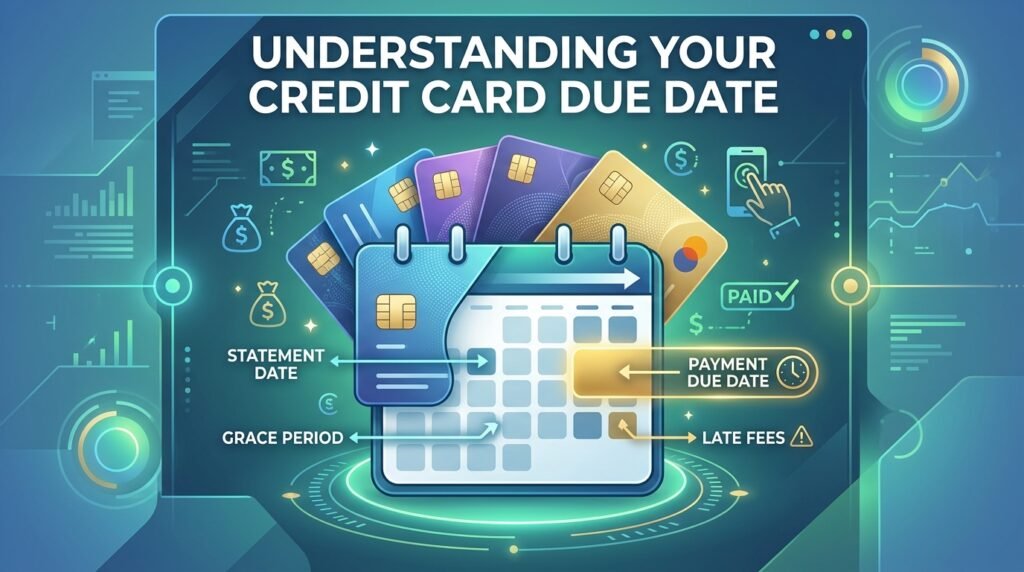
A credit card payment due date is one of the most important dates to understand when using a credit card. It tells you when your required payment must be received by the card issuer. Paying on time can help you avoid late fees and keep your account in good standing.
However, the due date can be confusing because it is connected to your billing cycle, statement balance, minimum payment, and grace period. Understanding how these pieces work together can make it easier to manage your credit card and avoid unnecessary costs.
What Is a Credit Card Payment Due Date?
The credit card payment due date is the date by which your required payment must generally be received by your card issuer.
Your monthly credit card statement usually shows several important details, including:
- Statement balance
- Minimum payment due
- Payment due date
- Credit limit
- Available credit
- Recent transactions
- Interest charges, if applicable
The minimum payment is the smallest amount you are generally required to pay by the due date to keep the account current.
If you want to understand how minimum payments compare with paying your balance in full, see Credit Card Minimum Payment vs Full Payment: What It’s Really Costing You.
How Does the Billing Cycle Work?
The payment due date is connected to your credit card billing cycle.
A billing cycle is the period during which purchases, payments, fees, credits, and other transactions are recorded on your account.
At the end of the billing cycle, the credit card issuer generates a statement. That statement shows the activity during the completed cycle and the amount you owed at the end of that period.
After the statement is generated, you usually have a period of time before the payment due date.
For example, a simplified timeline might look like this:
- Billing cycle begins
- You make purchases and payments
- Billing cycle closes
- Statement is generated
- Payment due date arrives
The exact timing varies by credit card issuer and account.
What Is the Minimum Payment Due?
The minimum payment is the smallest payment your card issuer requires by the due date.
It is important to understand that the minimum payment is not necessarily the amount you should pay every month if you can afford more.
For example, imagine your statement balance is $2,000, and your minimum payment is $60.
Paying $60 may satisfy the required payment for that billing cycle, but you could continue carrying a balance and potentially pay interest depending on your card terms.
Paying more than the minimum can reduce your balance faster and may reduce the amount of interest you pay over time.
What Happens If You Pay Before the Due Date?
Making a payment before the due date can help ensure that your required payment is received on time.
For example, if your payment due date is September 25, you do not necessarily need to wait until September 25 to make the payment. You can make it earlier according to your card issuer’s payment processing rules.
Paying early can also help you manage your monthly cash flow and reduce the risk of forgetting the payment.
However, make sure you understand when the issuer considers a payment received. Online payments may have specific processing requirements or cutoff times.
What Happens If You Pay on the Due Date?
Paying on the due date can still count as an on-time payment if the payment is received according to the card issuer’s requirements.
However, waiting until the last possible moment can create unnecessary risk.
For example, an online payment made late in the evening may not be treated the same way as a payment submitted earlier in the day. Payment cutoff times can vary by issuer.
If you are making a payment on the due date, check the issuer’s instructions and allow enough time for processing.
Setting up automatic payments can also help reduce the risk of accidentally missing the deadline.
What Happens If You Miss the Payment Due Date?
Missing the payment due date can have several consequences.
Depending on your card agreement and circumstances, you could face:
- A late payment fee
- Additional interest charges
- Loss of promotional terms in certain circumstances
- Negative credit reporting if the payment becomes sufficiently delinquent
- Other consequences described in your card agreement
The exact consequences depend on the card issuer, the terms of your account, and how late the payment becomes.
If you realize you missed a payment, check your account promptly and contact the card issuer if necessary.
Does Paying the Minimum Avoid a Late Payment?
Generally, making at least the required minimum payment by the due date can keep the account current for that payment cycle.
However, paying the minimum does not necessarily prevent interest from being charged.
If you carry a balance from one billing cycle to another, interest may accumulate according to your card’s terms.
This is why it is important to distinguish between avoiding a late payment and avoiding interest.
Paying the minimum may help you avoid being late, while paying the full statement balance may help you avoid interest on eligible purchases when the card’s grace-period requirements are met.
How Does the Grace Period Relate to the Due Date?
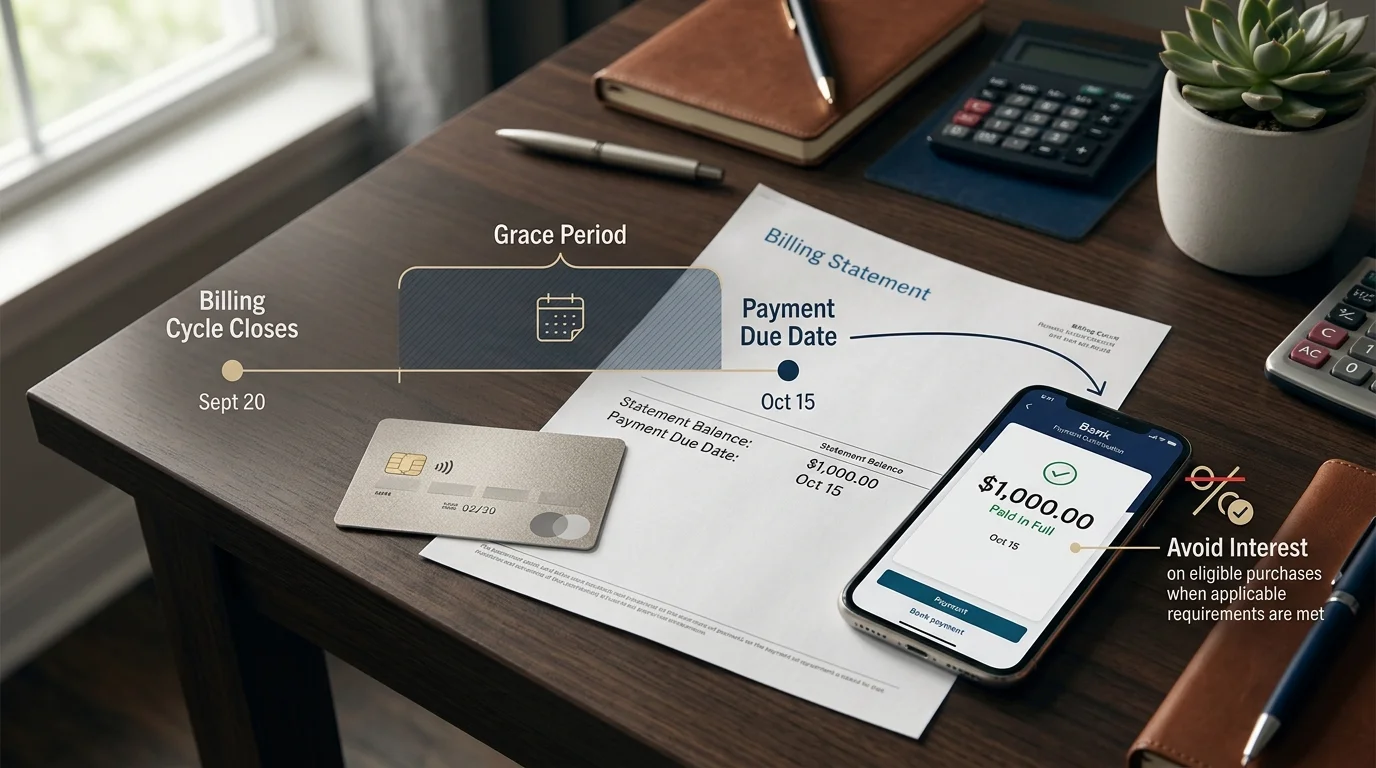
The grace period and payment due date are closely related, but they are not the same thing.
A grace period is generally the period between the end of a billing cycle and the payment due date during which eligible purchases may avoid interest if you meet the applicable requirements.
For example, suppose your billing cycle closes with a $1,000 statement balance. You then receive a payment due date several weeks later.
If your card offers a grace period for purchases and you meet the requirements, paying the full statement balance by the due date may allow you to avoid interest on those eligible purchases.
However, grace-period rules vary by card. Certain transactions, such as cash advances, may be treated differently.
Statement Balance vs. Current Balance
Another important distinction is between your statement balance and current balance.
Your statement balance is generally the amount shown on your most recent statement when the billing cycle closed.
Your current balance can change after the statement is generated because of new purchases, payments, refunds, credits, or other transactions.
For example:
Statement balance: $1,000
New purchase after statement closes: $200
Current balance: $1,200
In this situation, the $1,000 statement balance relates to the completed billing cycle, while the $1,200 current balance reflects newer account activity.
This is why your current balance may be different from the amount shown on your statement.
Should You Pay the Statement Balance or Current Balance?
The answer depends on your payment strategy and the terms of your credit card.
If your goal is to pay the statement balance in full, you generally focus on the statement balance shown on your statement and make that payment by the due date.
Paying the current balance can also pay off newer purchases that occurred after the statement closed.
For example, if your statement balance is $1,000 but your current balance has increased to $1,300 because of new purchases, paying $1,300 would cover both the statement balance and the newer charges, assuming no additional transactions occur.
However, you should always review your card’s terms to understand how payments and interest apply.
Why the Payment Due Date Matters for Interest
The due date can have a significant effect on the cost of carrying credit card debt.
If you carry a balance, interest can accumulate according to your card’s APR and billing terms.
Higher APRs can make it more expensive to carry a balance from month to month.
If you are struggling with high-interest credit card debt, a balance transfer may be one option to research. A balance transfer card may offer a promotional APR for eligible transferred debt, although fees and other conditions can apply.
You can learn more about the process in What Is a Balance Transfer Credit Card and How Does It Work?.
A balance transfer does not eliminate debt, so you should still have a realistic repayment plan before using one.
How to Avoid Missing Your Due Date
There are several simple ways to make credit card payments more manageable.
Set Up Autopay
Automatic payments can help ensure that at least the required minimum is paid on time.
Use Calendar Reminders
If you prefer making payments manually, add the due date to your calendar.
Pay Earlier
Do not wait until the last possible moment if you can make your payment earlier.
Check Your Statement
Review your statement every month so you know the exact minimum payment, statement balance, and due date.
Monitor Your Account
Checking your credit card account regularly can help you identify unexpected transactions and changes to your balance.
What If the Due Date Falls on a Weekend or Holiday?
The treatment of weekends and holidays can depend on the card issuer and applicable rules.
Your statement should provide the official payment due date and instructions for making payments.
If you are unsure how your issuer handles payments submitted on weekends or holidays, check the card agreement or contact the issuer directly.
It is generally better to make payments early rather than relying on a last-minute payment around a weekend or holiday.
Final Thoughts
A credit card payment due date tells you when your required payment needs to be received by the card issuer. Understanding this date is important because missing it can lead to fees and other potential consequences.
The due date is only one part of credit card management. You should also understand your billing cycle, statement balance, current balance, minimum payment, APR, and grace-period rules.
If possible, paying your statement balance in full can help you avoid interest on eligible purchases when your card’s terms allow it. If paying the full balance is not possible, paying more than the minimum can generally help reduce your balance faster.
The most important habit is to know your due date, make at least the required payment on time, and understand the terms that apply to your specific credit card.