
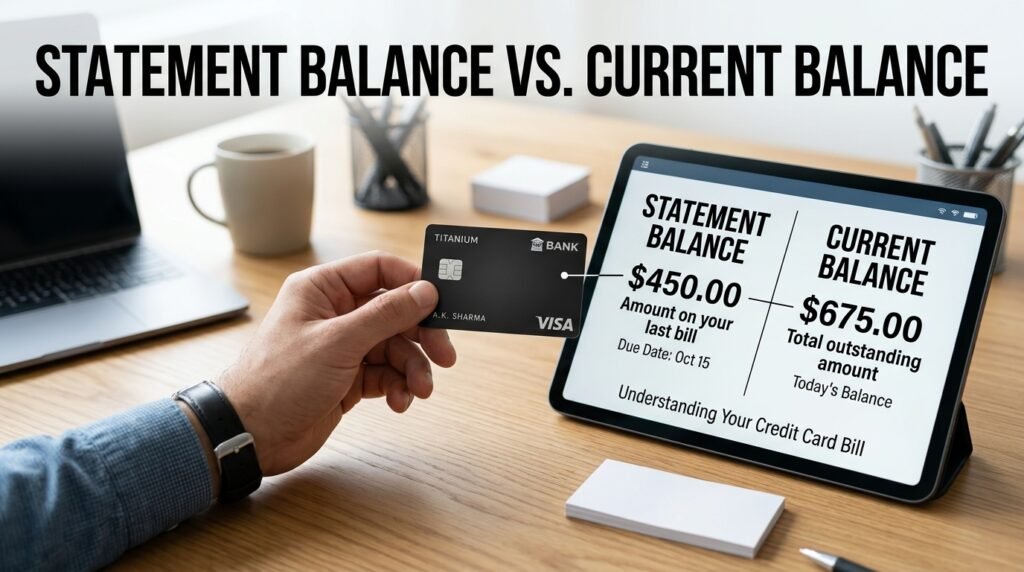
If you use a credit card regularly, you may notice two different numbers when checking your account: the statement balance and the current balance. Although both numbers represent money you owe, they are not necessarily the same.
Understanding the difference between a credit card statement balance vs. current balance can help you make payments correctly, avoid unnecessary interest, and keep better track of your spending.
The statement balance is generally the amount shown on your credit card statement for a completed billing cycle. The current balance can change throughout the month as you make new purchases, receive credits, or make payments.
Knowing how these balances work can make credit card payments easier to manage.
What Is a Credit Card Statement Balance?
Your credit card statement balance is the amount you owed at the end of a particular billing cycle.
A billing cycle usually covers a specific period, such as 25 to 31 days, although the exact length depends on the card issuer. When the billing cycle closes, the issuer generates your monthly statement.
The statement may include:
- Purchases made during the billing cycle
- Fees charged during the cycle
- Interest charges, if applicable
- Credits or refunds
- Payments made during the cycle
- The resulting statement balance
For example, suppose you started a billing cycle with a $500 balance and made $1,000 in new purchases. You then made a $300 payment before the billing cycle ended.
Your statement balance could be $1,200, depending on other transactions and charges.
Once the statement is generated, that balance becomes the amount associated with that particular monthly statement.
What Is a Credit Card Current Balance?
Your current balance is the amount you owe on the card at a particular point in time.
Unlike the statement balance, it can change every day.
For example, imagine your statement balance is $1,000. After the statement closes, you make another $200 purchase. Your current balance could then increase to $1,200.
If you subsequently make a $300 payment, your current balance could fall to $900.
This means your current balance may include transactions that were not part of your most recent statement.
Because of this, your current balance and statement balance can be different even when your account is completely up to date.
Statement Balance vs. Current Balance: Key Difference
The easiest way to understand the difference is to think about timing.
The statement balance represents what you owed when the previous billing cycle ended. The current balance represents what you owe right now, including transactions that may have happened after the statement was generated.
Consider this example:
- Statement balance: $1,500
- New purchases after statement closing: $300
- Payment after statement closing: $400
- Current balance: $1,400
The $1,500 statement balance belongs to the completed billing cycle. The $1,400 current balance reflects the newer activity on the account.
Both figures can be correct at the same time.
Which Balance Should You Pay?
For many credit card users, the statement balance is the key figure to understand when trying to avoid interest on eligible purchases.
If your card has a grace period and you meet the applicable requirements, paying the full statement balance by the payment due date can help you avoid interest on purchases.
However, the exact rules depend on the credit card agreement. Some transactions, such as cash advances, may be treated differently.
If you want to understand how payment amounts affect interest and repayment costs, see Credit Card Minimum Payment vs Full Payment: What It’s Really Costing You.
The minimum payment shown on your statement is different from the statement balance. Paying only the minimum generally keeps the account current but can result in interest charges and a longer repayment period if you carry a balance.
Does Paying the Current Balance Pay Everything?
Paying the current balance can cover more than your statement balance because it may include purchases made after the statement closed.
For example:
Your statement balance is $800, but you make another $150 purchase before the due date. Your current balance may now be $950.
If you pay the entire $950, you have paid both the statement balance and the newer purchase.
However, you do not necessarily need to pay the current balance every time to satisfy the statement amount. If your goal is to pay the statement balance in full, focus on the amount shown on the statement and follow the card issuer’s terms.
Does Statement Balance Affect Your Credit Score?
Credit card balances can play a role in credit utilization, which is one factor considered by many credit scoring models.
Credit utilization generally compares revolving balances with available credit. The balance reported by your card issuer can therefore matter when your credit information is updated.
For example, if your credit limit is $5,000 and a $2,000 balance is reported, the utilization ratio would be 40%.
The timing of your balance matters because the balance reported to credit bureaus may not be the same as the amount you see as your current balance.
For a deeper explanation of how reported balances and credit utilization work, see Credit Utilization Explained: The 30% Rule (And When It Doesn’t Apply).
This is one reason people who use a large percentage of their available credit may sometimes make a payment before the statement closes. However, credit scoring depends on multiple factors, and there is no guaranteed score change from making an early payment.
What Happens When You Make a Payment?

When you make a credit card payment, your current balance generally decreases after the payment is processed.
Suppose your current balance is $1,200 and you make a $500 payment. Once the payment is processed, your current balance may become $700, assuming no other transactions occur.
However, your previous statement balance does not change simply because you made a payment after the statement was generated. The payment is recorded as a transaction against the account.
Your next statement will reflect the new activity and payments that occurred during the next billing cycle.
What If Your Statement Balance Is $0?
A $0 statement balance means that no amount was owed at the end of that particular billing cycle.
However, your current balance could still be greater than $0 if you made purchases after the statement closed.
For example:
- Statement balance: $0
- New purchase: $200
- Current balance: $200
You may see a $0 statement balance while also seeing $200 as your current balance.
This is normal and does not necessarily mean there is a problem with your account.
How the Grace Period Fits In
The relationship between the statement balance, payment due date, and grace period is important.
A grace period is the period between the end of a billing cycle and the payment due date during which eligible purchases may avoid interest when the required conditions are met.
For example, if your statement closes with a $1,000 balance and your payment due date comes later, paying the full statement balance by the due date may allow you to avoid interest on eligible purchases.
However, grace period rules vary by card. If you already carry a balance, the way new purchases are treated can be different.
Understanding the credit card grace period can therefore help you understand when paying your statement balance in full may prevent interest charges.
Statement Balance vs. Current Balance Example
Imagine you have a credit card with a $5,000 credit limit.
During the billing cycle, you spend $1,200. The billing cycle closes, and your statement balance is $1,200.
After the statement is generated, you make another $300 purchase.
Your current balance is now $1,500.
If you then make a $500 payment, your current balance could fall to $1,000.
The original statement balance remains $1,200 for that completed billing cycle, while the current balance changes based on your latest transactions.
This example shows why the two numbers can move independently.
Common Mistakes to Avoid
One common mistake is assuming that the statement balance and current balance are always identical. They can differ whenever transactions occur after the statement closes.
Another mistake is paying only the minimum without understanding the potential interest costs. Minimum payments can keep an account current, but they may not prevent interest from accumulating on carried balances.
Some cardholders also assume that a $0 statement balance means they cannot currently owe anything. New purchases made after the statement closing date can create a current balance before the next statement is issued.
Finally, avoid ignoring the payment due date. Paying late can result in fees and potentially affect your credit history.
Final Thoughts
The difference between a credit card statement balance vs. current balance mainly comes down to timing.
Your statement balance reflects the amount shown when a billing cycle closes, while your current balance reflects your account activity at a more recent point in time.
Understanding both numbers can help you make informed payments, monitor your spending, manage interest costs, and understand how credit card balances may be reported.
Before making a payment, check your statement balance, current balance, minimum payment, and due date. Then review your card’s terms to understand how payments and interest work for your specific account.