
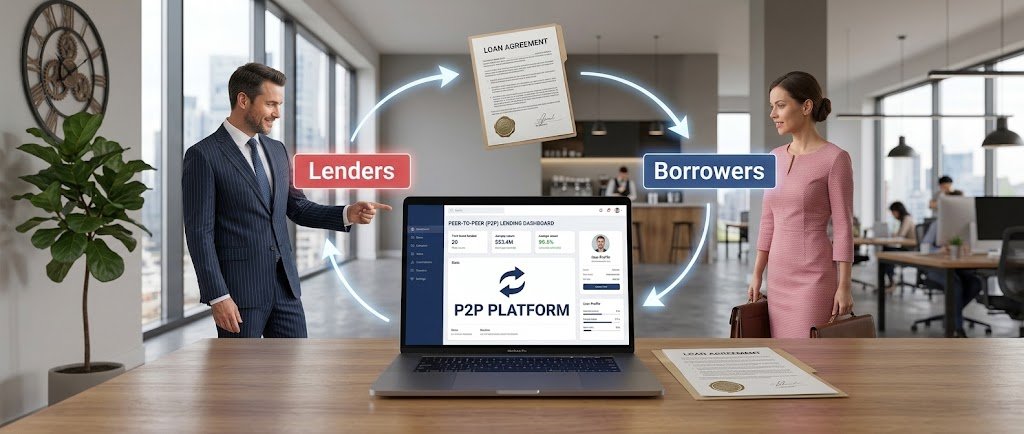
Imagine needing $12,000 to consolidate credit card debt, and instead of a bank approving or denying you, two hundred strangers each agree to lend you $60. That’s peer-to-peer lending in a nutshell — an online model that connects borrowers directly with individual and institutional investors, cutting the traditional bank out of the middle.
P2P platforms grew up promising faster approvals, looser standards, and better rates for borrowers who don’t fit the banking mold. Some of that promise holds. Some of it doesn’t. Here’s how peer-to-peer lending actually works, what it costs, and whether it’s truly safer than borrowing from a bank.
How Peer-to-Peer Lending Actually Works
Despite the “person-to-person” branding, modern P2P lending is a structured, technology-driven process:
- You apply online and submit income, employment, and identity information.
- The platform runs a credit check — usually a soft inquiry for prequalification, then a hard inquiry if you formally accept an offer.
- You receive a risk grade. The platform assigns a rating based on your creditworthiness, and that grade determines your interest rate. Riskier borrowers pay more.
- Your loan is listed for funding. Investors browse listings and commit money in small increments, often spreading $5,000 across dozens of loans to dilute default risk.
- You repay the platform monthly, and it distributes payments to investors — minus servicing fees.
From your side as a borrower, the experience feels a lot like any online installment loan: fixed monthly payments, a set term, and an origination fee. The CFPB’s explainer on what a personal loan is covers the fundamentals that apply here too.
Peer-to-Peer Lending vs. Bank Loans: The Real Differences
The structural differences matter more than the marketing.
Approval flexibility. P2P platforms often approve borrowers with fair credit that banks decline — but that flexibility prices itself in. If your grade lands low, the APR can climb well into the high teens or beyond, sometimes with an origination fee of 1% to 8% deducted from your proceeds before you receive the money. Ask for $12,000 with a 5% fee, and $11,400 shows up in your account while you owe the full $12,000.
Speed. Decisions can come in minutes and funding in days — comparable to online banks, faster than traditional branches.
Consistency. Bank loans are funded by the institution itself. On a P2P platform, your loan must attract enough investor interest to fund. Most do, but it’s an extra variable.
The smart move before committing to any route is understanding pre-approval vs. pre-qualification so you can compare real numbers without unnecessary hard pulls.
Is Peer-to-Peer Lending Safe for Borrowers?
Here’s the reassuring part: from a borrower’s perspective, peer-to-peer lending is regulated much like other consumer lending. The borrowing side falls under CFPB and FTC oversight, and federal laws covering fair lending, truthful disclosures, and billing rights apply. You sign a legally binding promissory note, your payments are reported to the credit bureaus, and your obligations are essentially the same as with any installment loan.
The risks are practical rather than legal:
- Higher total cost for lower-grade borrowers once fees and APR are combined
- Data security — you’re handing sensitive financial information to a tech platform
- Servicing transfers — loans are sometimes sold or servicing moves, which can create confusion
- Aggressive marketing of refinancing that may not actually improve your position
One often-missed point: every formal application triggers a hard inquiry, which can temporarily trim your score. myFICO’s overview of credit inquiries explains how those checks factor into FICO scoring. That’s why prequalification matters — and why reading up on your personal loan credit impact before you apply is time well spent.
What Happens if You’re Approved — or Denied
If approved, treat a P2P loan like any other debt: autopay on, extra principal payments when possible, and a clear payoff date circled on the calendar. If the loan’s purpose is consolidating higher-interest debt, compare the P2P quote against a debt settlement vs. debt consolidation strategy first — settlement in particular carries credit consequences many borrowers underestimate.
If denied, don’t fire off five more applications in a panic. Multiple recent inquiries compound the damage. Instead, figure out why — our guide on handling a rejected loan application walks through the usual suspects: utilization too high, income documentation weak, or too many recent applications. Borrowers with thinner credit files may have better luck with a credit-builder product than with another mainstream application; see our notes on bad-credit personal loans for realistic expectations.
Common Mistakes with Peer-to-Peer Lending
- Comparing monthly payments instead of APR. Stretching a term to lower the payment raises the total cost.
- Ignoring the origination fee math. Always calculate the fee into the effective rate.
- Taking the first offer. P2P, bank, and credit union quotes vary widely — shop at least two.
- Refinancing federal student loans through a P2P platform. You’d permanently lose income-driven repayment and forgiveness options.
- Borrowing for wants, not needs. A fixed-rate installment loan for a vacation is still debt.
Practical Takeaways
- Peer-to-peer lending is a legitimate, regulated way to borrow — structurally similar to a personal loan.
- It’s often most competitive for borrowers with good credit; weaker profiles pay for flexibility.
- Origination fees are deducted from proceeds — factor them into your real APR.
- The model is safe for borrowers when you verify the platform, read the note, and compare alternatives.
- A denial isn’t a verdict; fix the underlying issue before reapplying anywhere.
Final Thoughts
So, is borrowing from individuals safer than a bank? For borrowers, peer-to-peer lending carries roughly the same legal protections as traditional consumer lending — the real question is cost, not safety. Run the numbers against at least one bank or credit union quote, and the right choice usually announces itself.
This article is for educational purposes only and is not personalized financial advice. Loan terms, fees, and eligibility vary by platform and borrower; always review official disclosures before accepting any loan.