
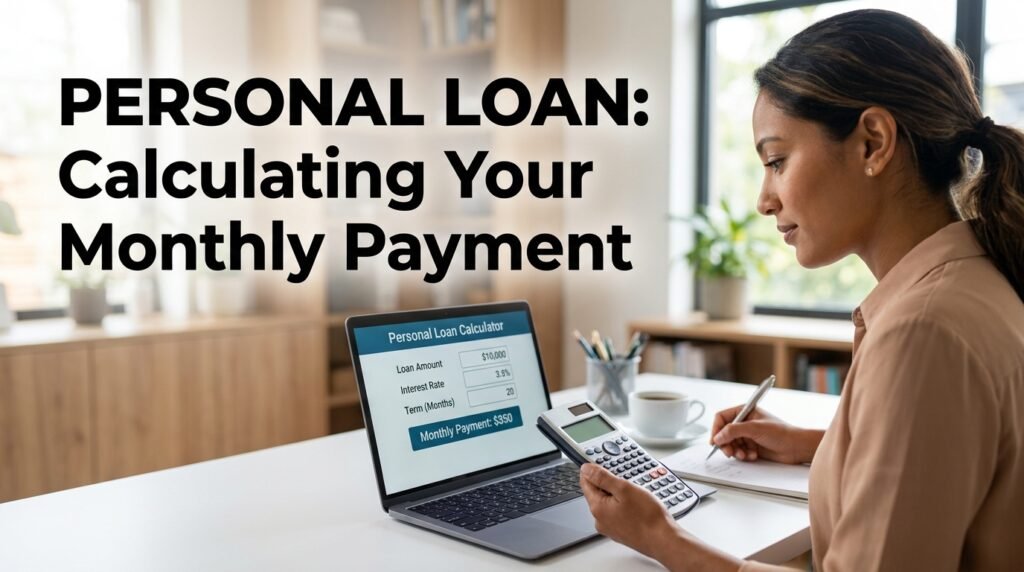
A personal loan monthly payment is the amount a borrower is required to pay toward a personal loan each month. This payment usually includes both principal and interest, although the exact structure depends on the loan terms.
Before taking out a personal loan, understanding how the monthly payment is calculated can help you determine whether the loan fits your budget. A loan with a lower monthly payment may look attractive, but a longer repayment period can result in more interest paid over time.
Several factors affect your monthly payment, including the loan amount, interest rate, and repayment term.
What Is a Personal Loan Monthly Payment?
A personal loan monthly payment is the scheduled amount you pay to the lender each month until the loan is fully repaid.
For a typical fixed-rate personal loan, the monthly payment generally remains the same throughout the repayment period. Each payment is divided between interest and principal.
At the beginning of the loan, a larger portion of the payment may go toward interest. As the outstanding principal decreases, more of each payment may go toward reducing the principal balance.
For example, if you borrow $10,000 for three years, your monthly payment will depend on the interest rate and other applicable loan costs.
What Factors Determine a Personal Loan Monthly Payment?
Several factors influence how much you pay each month.
Loan Amount
The amount you borrow has a direct effect on your monthly payment.
Borrowing $20,000 will generally result in a higher monthly payment than borrowing $10,000 if the interest rate and repayment term are otherwise the same.
For this reason, borrowing only what you need can help keep your monthly obligation manageable.
Interest Rate
The interest rate determines how much you pay the lender for borrowing the money.
A higher interest rate generally produces a higher monthly payment and increases the total interest paid over the life of the loan.
Your rate may depend on factors such as credit history, income, debt obligations, loan amount, and lender requirements.
Loan Term
The loan term is the amount of time you have to repay the loan.
A shorter term generally means higher monthly payments but less time for interest to accumulate.
A longer term can lower the monthly payment, but you may pay more total interest because the balance remains outstanding for a longer period.
Fees
Some personal loans include fees such as origination fees or other charges.
Fees may not always be included directly in the monthly payment, but they can increase the overall cost of borrowing. Before comparing loans, it is useful to look beyond the monthly payment and consider the total borrowing cost.
Our guide on How to Calculate the True Cost of a Personal Loan Before You Sign explains how interest, fees, and repayment terms can affect the actual cost of a loan.
How Is a Personal Loan Monthly Payment Calculated?
For a typical fixed-rate installment loan, lenders can use a standard amortization formula to calculate the monthly payment.
The formula is:
M = P × [r(1 + r)^n] ÷ [(1 + r)^n – 1]
Where:
- M = monthly payment
- P = principal loan amount
- r = monthly interest rate
- n = total number of monthly payments
The annual interest rate is generally converted into a monthly rate for this calculation.
For example, if the annual interest rate is 12%, the monthly rate used in the formula would be 1%, or 0.01.
The number of payments depends on the loan term. A three-year loan would normally have 36 monthly payments, while a five-year loan would have 60.
Example of a Personal Loan Monthly Payment
Suppose you borrow $10,000 at a fixed 12% annual interest rate for three years.
The loan would have:
- Principal: $10,000
- Annual interest rate: 12%
- Monthly interest rate: 1%
- Repayment term: 36 months
Using the standard loan payment formula, the monthly payment would be approximately $332.
Over 36 payments, the total amount repaid would be approximately $11,957.
That means roughly $1,957 would represent interest over the repayment period, before considering any separate fees.
This example is for illustration only. Actual loan payments vary based on the lender, APR, fees, loan terms, and other factors.
Why Does the Monthly Payment Change With the Loan Term?
The repayment term can have a significant effect on your monthly payment.
Suppose you borrow the same $10,000 at the same interest rate but choose a longer repayment period.
With a longer term, the loan balance is spread across more monthly payments. This generally reduces the amount you are required to pay each month.
However, you may pay more total interest because the loan remains outstanding for a longer period.
This creates an important trade-off:
Shorter term: Higher monthly payment, potentially lower total interest.
Longer term: Lower monthly payment, potentially higher total interest.
When comparing loans, it is therefore important to look at both the monthly payment and total repayment amount.
How Does APR Affect Your Monthly Payment?
APR, or annual percentage rate, can provide a broader picture of borrowing costs because it can include the interest rate and certain loan fees.
Two personal loans may advertise similar interest rates but have different APRs because their fees differ.
For borrowers comparing offers, looking at APR alongside the monthly payment can make it easier to understand the overall cost of borrowing.
However, you should still review the loan agreement for the specific fees and terms that apply to your offer.
How Does Your Debt-to-Income Ratio Affect Affordability?
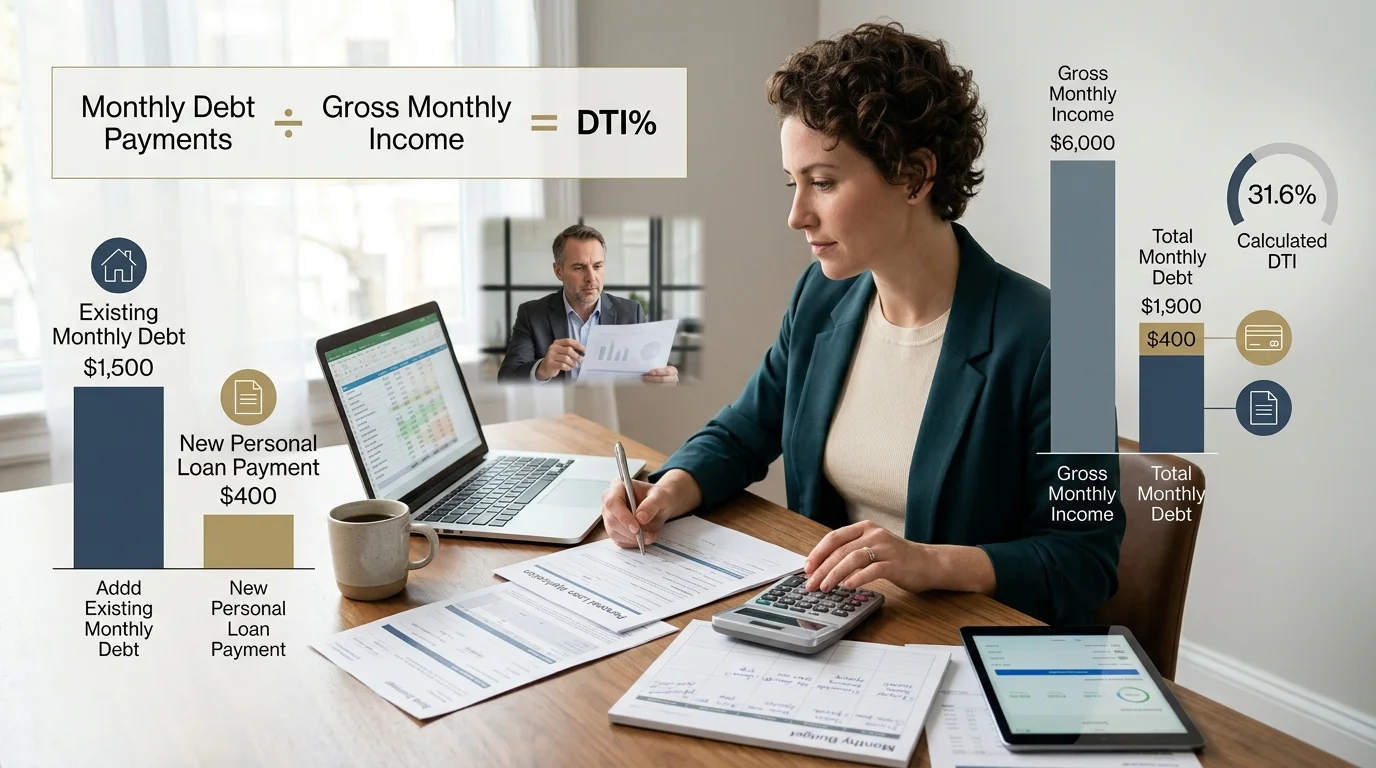
Your debt-to-income ratio, or DTI, compares your monthly debt obligations with your gross monthly income.
A new personal loan payment can increase your monthly debt obligations, which can affect your DTI.
For example, if you already have $1,500 in monthly debt payments and add a new $400 personal loan payment, your total monthly debt obligations would become $1,900.
Lenders may consider DTI when evaluating whether you can manage additional debt.
You can learn more about this calculation in Debt-to-Income Ratio Explained: What Lenders Look at Before Approving Your Loan.
How Can You Estimate a Monthly Payment Before Applying?
You do not necessarily need to wait for a lender to provide a final offer before estimating your monthly payment.
You can use an online personal loan calculator and enter:
- Desired loan amount
- Estimated interest rate
- Repayment term
- Number of payments
The calculator can provide an estimated monthly payment and total repayment amount.
However, remember that an estimate is not the same as a lender’s final offer. Your actual APR, fees, and loan terms may be different.
Can You Lower Your Personal Loan Monthly Payment?
There are several ways a borrower may potentially reduce the monthly payment.
Borrow Less
The simplest approach is to reduce the amount you borrow.
If you need $10,000 but can complete your project with $8,000, borrowing less can reduce the monthly obligation.
Choose a Longer Repayment Term
A longer term can reduce the required monthly payment because the balance is spread across more payments.
However, compare the total interest before choosing this option.
Compare Multiple Lenders
Different lenders may offer different interest rates, fees, and repayment terms.
Comparing multiple offers can help you understand the range of available monthly payments and total borrowing costs.
Improve Your Credit Profile
Depending on the lender, stronger credit may help you qualify for more favorable loan terms.
Before applying, review your credit information and address errors if you find any.
Should You Focus Only on the Monthly Payment?
No.
A low monthly payment does not necessarily mean a loan is inexpensive.
For example, extending a loan from three years to five years can lower the monthly payment while increasing the total amount of interest paid.
When comparing personal loans, consider:
- Monthly payment
- Interest rate
- APR
- Loan term
- Origination fees
- Total repayment amount
- Prepayment terms
- Late payment fees
Looking at these factors together provides a clearer picture of the loan’s overall cost.
Can Making Extra Payments Reduce Loan Costs?
Depending on your loan terms, making additional payments may help reduce the outstanding principal faster.
When the principal decreases more quickly, there may be less interest to accumulate over the remaining repayment period.
However, check your loan agreement first. Some lenders may have specific rules for additional payments or early repayment.
Our guide on How to Pay Off a Personal Loan Faster and Save on Interest covers strategies such as making extra payments, using additional income, and reviewing refinancing options.
Final Thoughts
A personal loan monthly payment depends primarily on the amount borrowed, interest rate, and repayment term. Fees and other loan terms can also affect the overall cost of borrowing.
A longer loan term can make monthly payments more manageable, but it may increase total interest. A shorter term can reduce the repayment period and potentially lower total interest, but the monthly payment may be higher.
Before accepting a personal loan, calculate the expected monthly payment and compare it with your income, existing debt, and regular expenses.
Most importantly, do not judge a loan only by its monthly payment. Review the APR, fees, repayment term, and total amount you will repay to understand the complete cost.
Frequently Asked Questions
How is a personal loan monthly payment calculated?
A typical fixed-rate personal loan payment is calculated using the loan amount, monthly interest rate, and total number of monthly payments. The resulting payment generally includes both principal and interest.
What makes a personal loan payment higher?
A larger loan amount, higher interest rate, or shorter repayment term can generally increase the required monthly payment.
Does a longer loan term lower monthly payments?
Generally, yes. A longer repayment term spreads the loan balance across more payments, which can reduce the monthly payment. However, it may increase total interest costs.
Does APR affect personal loan payments?
APR can reflect the interest rate plus certain fees and is useful for comparing borrowing costs. The specific monthly payment depends on the loan’s rate, amount, term, and applicable terms.
Can I pay more than my required personal loan payment?
Many lenders allow additional payments, but you should check your loan agreement to understand how extra payments are applied and whether any prepayment restrictions or fees apply.
What should I consider besides the monthly payment?
Consider the APR, interest rate, loan term, origination fees, total repayment amount, prepayment terms, and whether the payment fits comfortably within your budget.