
When you take out a personal loan, the loan term is one of the most important factors to consider. The term determines how long you have to repay the borrowed money and can directly affect your monthly payment and total borrowing cost.
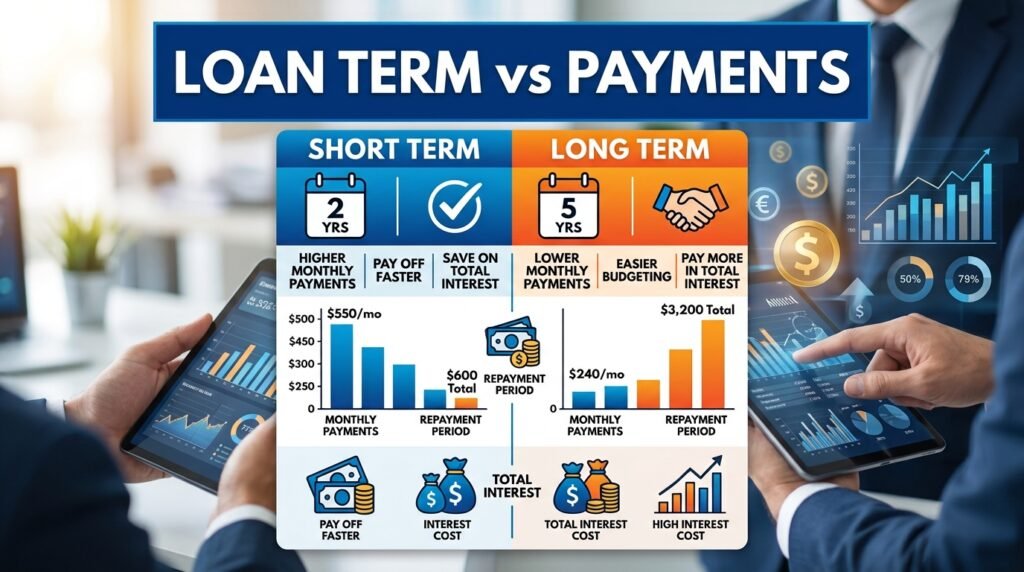
A shorter personal loan term may result in higher monthly payments but less interest paid over time. A longer term can make monthly payments more manageable, but you may pay more interest over the life of the loan.
Understanding how personal loan term length affects your payments can help you compare loan offers and choose a repayment schedule that fits your budget.
What Is a Personal Loan Term Length?
Personal loan term length refers to the amount of time you have to repay the loan.
For example, a lender might offer personal loans with terms of 12, 24, 36, 48, or 60 months. Some lenders may offer shorter or longer repayment periods.
If you borrow $10,000 with a 36-month term, you generally make scheduled monthly payments for three years. A 60-month term would spread repayment over five years.
The loan term does not determine the interest rate by itself. However, it affects how long you are paying interest and therefore can have a major impact on your total repayment cost.
How Does Loan Term Length Affect Monthly Payments?
One of the most noticeable effects of choosing a loan term is the monthly payment.
A longer repayment period spreads the loan balance across more months. As a result, the required monthly payment may be lower.
For example, imagine you borrow $10,000 at the same interest rate under two different terms:
- Three-year term: higher monthly payment
- Five-year term: lower monthly payment
The five-year loan may be easier to fit into your monthly budget because you have more time to repay the balance.
However, the lower monthly payment does not necessarily mean the loan is cheaper.
Because the five-year loan remains outstanding for a longer period, you may pay more interest overall.
Short-Term vs. Long-Term Personal Loans
Choosing between a short and long repayment period involves balancing monthly affordability with total borrowing costs.
Short-Term Personal Loan
A short-term loan generally requires you to repay the balance faster.
Potential advantages include:
- Higher monthly payments
- Faster debt repayment
- Less time paying interest
- Potentially lower total interest cost
The main drawback is that the higher monthly payment may put more pressure on your budget.
Long-Term Personal Loan
A long-term loan spreads repayment over more months.
Potential advantages include:
- Lower monthly payments
- More flexibility in the monthly budget
- Longer repayment period
However, the longer term can mean paying interest for a longer period, potentially increasing the total cost of borrowing.
Why Does a Longer Loan Term Usually Cost More?
Interest is generally charged based on the outstanding loan balance and the applicable interest rate.
When you extend the repayment period, the balance remains outstanding for a longer period.
For example, imagine two loans have the same principal and interest rate but different terms. The loan with the longer term generally gives you more time to repay the balance, which can result in more total interest paid.
This is why borrowers should not compare personal loans based only on their monthly payments.
A loan with a $250 monthly payment may look more affordable than one with a $350 payment, but the $250 payment could continue for significantly longer.
For a detailed breakdown of interest, fees, loan terms, and total repayment costs, read our guide on How to Calculate the True Cost of a Personal Loan Before You Sign.
How Loan Term Affects Total Interest
Consider a simplified example.
Suppose you borrow $10,000 at a fixed interest rate.
With a shorter repayment term, your monthly payment may be higher, but you pay off the principal sooner.
With a longer repayment term, your monthly payment may be lower, but you keep the loan longer.
The result is that the longer-term loan can accumulate more interest.
The exact difference depends on the loan amount, interest rate, fees, and repayment schedule.
This is why it is useful to calculate the total amount you will repay before accepting a loan.
What Loan Term Should You Choose?
There is no single loan term that works for every borrower.
The right term depends on your income, monthly expenses, existing debt, interest rate, and financial goals.
If you can comfortably afford a higher monthly payment without putting your budget under pressure, a shorter term may reduce the time you remain in debt and potentially reduce total interest.
If a shorter term would make your monthly budget too tight, a longer term may provide more manageable payments.
The key is to choose a payment that you can realistically maintain throughout the loan.
Consider Your Debt-to-Income Ratio
Your debt-to-income ratio, or DTI, compares your monthly debt payments with your gross monthly income.
When considering a personal loan, you should look at how the new payment fits alongside your existing obligations.
For example, if you already have credit card payments, an auto loan, or student loan payments, adding a personal loan could increase your monthly debt obligations.
Our guide on Debt-to-Income Ratio Explained: What Lenders Look at Before Approving Your Loan explains how DTI works and why lenders consider it.
Even if a lender approves a loan, you should independently evaluate whether the payment fits your actual household budget.
Should You Choose the Shortest Loan Term?

Not necessarily.
A shorter term can reduce the amount of time you pay interest, but the higher monthly payment may not be suitable for everyone.
For example, suppose you earn $4,000 per month and have significant housing, transportation, food, insurance, and debt expenses.
Choosing a very short loan term could leave you with little money available for emergencies or unexpected expenses.
A slightly longer term may provide more monthly flexibility.
The goal should not simply be to choose the shortest possible term. Instead, consider the relationship between monthly affordability and total borrowing cost.
Can You Pay Off a Personal Loan Early?
Some borrowers choose a longer loan term for flexibility and then make additional payments when their finances allow.
Depending on the lender and loan agreement, extra payments may help reduce the outstanding principal and potentially shorten the repayment period.
However, you should check the loan agreement before making additional payments.
Look for information about:
- Prepayment penalties
- Additional principal payments
- Payment application rules
- Early payoff requirements
- Payoff quotes
If your loan allows penalty-free extra payments, making additional payments could help you repay the loan faster.
For more practical strategies, including extra payments, biweekly payments, refinancing, and budgeting, read How to Pay Off a Personal Loan Faster and Save on Interest.
What Happens If You Extend a Loan Term?
Some borrowers may consider refinancing or extending a loan term to reduce their monthly payment.
While this can make the payment easier to manage, extending the repayment period can increase the total interest paid.
For example, if you have two years remaining on a loan and refinance it into a new five-year loan, the new monthly payment may be lower. However, you may end up paying interest over a much longer period.
Before extending a loan, compare:
- New interest rate
- New APR
- Remaining balance
- New loan term
- Monthly payment
- Origination fees
- Total interest
- Total repayment amount
A lower monthly payment is only one part of the calculation.
How to Compare Personal Loan Terms
When comparing personal loan offers, create a simple comparison.
Look at the following:
Loan Amount
How much money will you actually receive?
Interest Rate
What interest rate does the lender offer?
APR
What is the APR after applicable fees?
Loan Term
How many months will you make payments?
Monthly Payment
Can you comfortably afford the required payment?
Total Repayment
How much will you pay over the entire loan term?
Fees
Are there origination fees, late fees, or other charges?
Comparing these factors can give you a clearer picture of the actual cost of each loan.
Common Mistakes When Choosing a Loan Term
One common mistake is choosing the longest term simply because it produces the lowest monthly payment.
Another is choosing a very short term without considering whether the payment is sustainable.
Borrowers can also overlook fees and focus only on the interest rate.
Finally, some people compare loans based only on monthly payments instead of calculating the total amount they will repay.
A personal loan should fit your overall financial situation, not just your preferred monthly payment.
Final Thoughts
Personal loan term length can have a significant effect on both your monthly payment and total borrowing cost.
A shorter term usually means higher monthly payments but less time paying interest. A longer term can reduce the monthly payment but may increase the total interest paid.
Before choosing a loan term, consider your income, existing debt, monthly expenses, emergency savings, interest rate, fees, and total repayment amount.
The best term is not necessarily the shortest or longest option. It is the one that provides a manageable payment while keeping the overall borrowing cost reasonable for your financial situation.