
Retirement investing is often discussed in terms of average returns. If a portfolio earns a certain average annual return over several decades, it may seem that the order of those returns should not matter.
However, things can change significantly once you begin withdrawing money from your investments.
This is where sequence-of-returns risk becomes important.
Sequence-of-returns risk is the risk that the timing and order of investment returns can negatively affect a retirement portfolio, particularly when poor returns occur around the beginning of retirement while the investor is also taking withdrawals.
Two investors can have portfolios with similar long-term average returns but experience very different outcomes if their yearly returns occur in a different order.
What Is Sequence-of-Returns Risk?
Sequence-of-returns risk refers to the potential impact of receiving poor investment returns early in retirement while withdrawing money from the portfolio.
During the accumulation stage, investors generally add money to their portfolios. A market decline can therefore be followed by additional contributions and future market recovery.
Retirement is different.
Once you stop working, you may begin taking money out of your portfolio to pay for living expenses. If the market falls at the same time, you may be selling investments while their values are lower.
This combination of investment losses and withdrawals can reduce the amount of money left in the portfolio and make it harder for the portfolio to recover.
Morningstar explains that the effect is especially important during the first few years before and after retirement because withdrawals can magnify the effect of unfavorable returns.
A Simple Example of Sequence Risk
Imagine two retirees each begin retirement with $500,000.
Both experience the same overall investment returns over several years, but the order is different.
Investor A experiences strong returns during the first few years and weaker returns later.
Investor B experiences poor returns at the beginning of retirement and stronger returns later.
If neither investor withdraws money, the difference caused by the order of returns can be much less important.
But if both investors withdraw money every year, Investor B may face a much greater challenge.
Why?
Because Investor B is withdrawing money from a portfolio that has already declined.
Suppose a portfolio falls from $500,000 to $400,000. If the retiree then withdraws $30,000, the portfolio has less capital available to participate in a future market recovery.
The problem is not simply that the market declined. The timing of the decline relative to withdrawals is what creates the additional risk.
Why Is the Beginning of Retirement So Important?
The first few years of retirement can have an outsized effect because the portfolio is often at or near its largest value, while withdrawals are beginning.
A major market decline early in retirement can force an investor to sell more shares to generate the same amount of cash.
For example, if you need $20,000 and your investments are worth $100 per share, you need to sell 200 shares.
If the investment falls to $50 per share, you need to sell 400 shares to generate the same $20,000.
Those additional shares are no longer available to participate in a future recovery.
This is one reason sequence risk is different from ordinary market volatility.
A temporary market decline during the accumulation stage may be easier to withstand because the investor is not depending on the portfolio for immediate income.
Sequence Risk vs. Average Returns
Average returns can be useful when evaluating long-term investments, but they do not tell the entire story for someone withdrawing money.
Consider two hypothetical portfolios that both achieve an average return of 6% over a period.
One portfolio experiences strong returns early and weaker returns later.
The other experiences poor returns early and stronger returns later.
If money is being withdrawn throughout the period, the second portfolio can end up in a weaker position because withdrawals occur while the portfolio is depressed.
This is why retirement planning should consider not only expected returns but also volatility, withdrawal rates, inflation, and the timing of market performance.
How Inflation Can Make Sequence Risk More Difficult
Inflation can add another layer of pressure.
If prices rise, retirees may need to withdraw more money over time to maintain the same standard of living.
For example, a retiree who spends $40,000 during the first year of retirement may need more than $40,000 in later years if the cost of housing, food, healthcare, transportation, and other necessities increases.
If the portfolio is simultaneously experiencing weak returns, increasing withdrawals can put additional pressure on the account.
Understanding how inflation affects purchasing power is therefore an important part of retirement planning. Our guide on inflation in Pakistan in 2026 and what it means for your money explains how rising prices can affect savings and purchasing power.
Can Diversification Help Reduce Sequence Risk?
Diversification cannot eliminate sequence-of-returns risk, but a diversified portfolio may behave differently from a portfolio concentrated in one asset class.
Stocks can experience substantial price movements, while bonds and cash may behave differently under certain market conditions.
A retirement portfolio containing a mix of investments may therefore provide different sources of return and liquidity.
However, diversification does not guarantee profits or prevent losses.
The appropriate asset allocation depends on factors such as your retirement timeline, income needs, risk tolerance, other sources of income, and financial goals.
Why Cash Reserves Can Matter
Having some accessible cash outside the investment portfolio may provide flexibility during periods of market weakness.
For example, if a retiree has enough cash to cover certain short-term expenses, they may not need to sell investments immediately after a major market decline.
This does not mean retirees should keep all their retirement savings in cash.
Cash typically has lower long-term growth potential than many investments and can lose purchasing power because of inflation.
Instead, some investors use cash reserves as part of a broader retirement-income strategy.
Our guide to emergency savings accounts and where to keep emergency money explains why liquidity and accessibility can matter when setting aside money for unexpected expenses.
Can a Target-Date Fund Eliminate Sequence Risk?
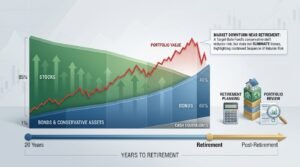
A target-date fund can automatically change its investment allocation as the target retirement date approaches, but it does not eliminate sequence-of-returns risk.
These funds generally follow a glide path that changes the mix of stocks, bonds, and other investments over time.
The exact strategy differs from one fund to another.
A target-date fund may become more conservative as retirement approaches, potentially reducing exposure to certain types of market volatility. However, the fund can still lose value during a market downturn.
Investors should therefore examine the fund’s asset allocation, fees, glide path, and approach to retirement rather than assuming that a target date automatically makes the portfolio safe.
You can learn more about how target-date funds work and how they adjust investments over time.
Strategies That May Help Manage Sequence Risk
There is no single strategy that completely removes sequence-of-returns risk.
However, retirees can consider several approaches as part of their broader retirement planning.
Maintain a Cash Reserve
Keeping some money in accessible, lower-volatility assets can provide a source of spending money during market declines.
Diversify the Portfolio
A diversified mix of assets can help avoid depending entirely on one investment category.
Review Withdrawal Rates
The amount withdrawn from a portfolio can have a major effect on how long the money lasts.
A fixed withdrawal amount may become more difficult to sustain after a major market decline.
Be Flexible With Spending
Some retirees may have essential expenses that cannot easily be reduced, while discretionary expenses may be more flexible.
Reducing optional spending during difficult market periods can potentially reduce the amount that needs to be withdrawn from investments.
Consider Multiple Income Sources
Retirement income may come from investments, pensions, Social Security, rental income, annuities, or other sources depending on the individual’s circumstances.
Having income sources outside the investment portfolio can reduce dependence on portfolio withdrawals.
Is Sequence-of-Returns Risk Only a Retirement Problem?
Sequence risk is particularly important during retirement because withdrawals make the timing of returns more significant.
During the accumulation stage, investors are generally adding money rather than withdrawing it.
If the market falls, new contributions can purchase investments at lower prices.
However, someone approaching retirement may have less time to recover from a major decline.
Someone already in retirement may have to sell investments to cover expenses, making the timing of losses even more important.
This is why investors should think about sequence risk before retirement rather than waiting until withdrawals begin.
Final Thoughts
Sequence-of-returns risk is the possibility that the order of investment returns, especially poor returns near the beginning of retirement, can negatively affect a portfolio that is being used for withdrawals.
The same average investment return can produce different retirement outcomes depending on when strong and weak returns occur.
This makes the years immediately before and after retirement particularly important.
Diversification, appropriate asset allocation, cash reserves, flexible spending, and a carefully considered withdrawal strategy can all play a role in managing retirement risk.
No strategy can guarantee that a portfolio will avoid losses or last throughout retirement. The goal is to understand how market returns, withdrawals, inflation, and timing interact so that retirement planning accounts for more than just an expected average return.