Bonds are often considered an important part of a diversified investment portfolio, particularly for investors looking for income and exposure to fixed-income investments. However, there are different ways to invest in bonds. Two common choices are buying individual bonds or investing through a bond fund.
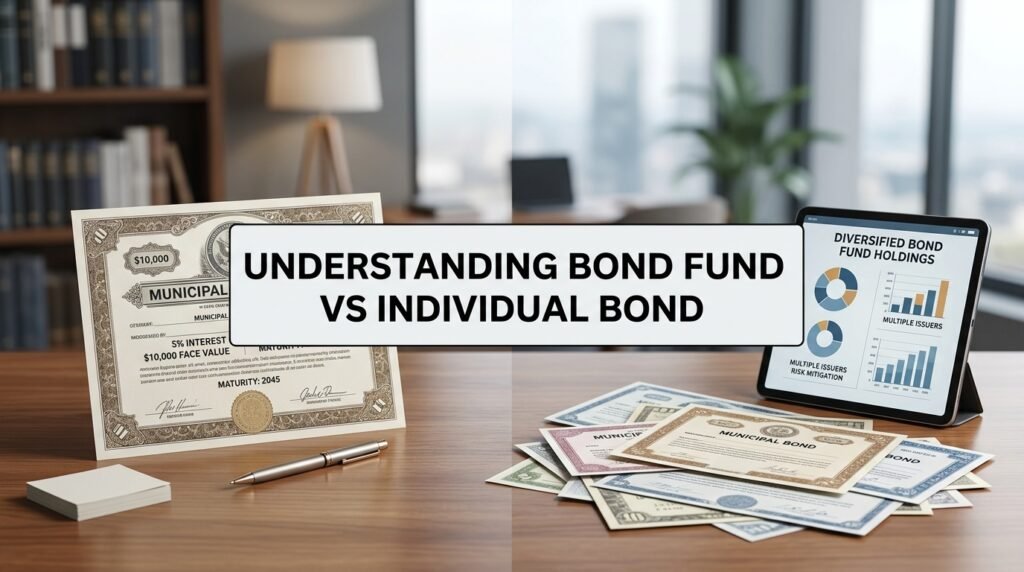
Although both options provide exposure to bonds, they work differently. An individual bond represents a specific debt investment issued by a company, government, or other organization. A bond fund, on the other hand, holds a portfolio of multiple bonds and is managed according to a specific investment strategy.
Understanding the difference between a bond fund and an individual bond can help investors compare diversification, maturity, income, risk, costs, and flexibility before choosing an investment.
What Is an Individual Bond?
An individual bond is a debt security issued by an organization that wants to borrow money.
When you purchase an individual bond, you are essentially lending money to the issuer. In return, the issuer generally agrees to pay interest according to the bond’s terms and return the principal at maturity.
For example, suppose you purchase a $1,000 bond with a fixed interest rate and a five-year maturity. If the issuer continues meeting its obligations, you may receive scheduled interest payments during those five years and receive the principal when the bond matures.
The actual terms depend on the bond.
Government bonds, municipal bonds, and corporate bonds can have different levels of risk, interest rates, maturity dates, and tax considerations.
What Is a Bond Fund?
A bond fund is an investment fund that owns a portfolio of bonds.
Instead of purchasing one bond directly, investors buy shares of the fund. The fund may hold dozens, hundreds, or even thousands of bonds depending on its strategy and size.
Bond funds can focus on different types of fixed-income securities. For example, a fund may invest primarily in government bonds, corporate bonds, municipal bonds, short-term bonds, or a combination of different securities.
The fund manager or management team handles the selection and management of the portfolio according to the fund’s objectives.
Bond funds can be structured as mutual funds or exchange-traded funds, commonly known as ETFs.
How Does a Bond Fund Work?
When you invest in a bond fund, your money is pooled with money from other investors.
The fund uses that money to purchase a portfolio of bonds. The value of your investment changes based on the value of the fund’s underlying securities and other factors.
A bond fund may receive interest payments from the bonds it owns. Those earnings can contribute to distributions made to fund investors, depending on the fund’s structure and policies.
Unlike an individual bond, a bond fund generally does not have one fixed maturity date for the entire investment.
The fund may continuously buy and sell bonds as part of its investment strategy.
Bond Fund vs. Individual Bond: Key Differences
The biggest differences involve diversification, maturity, pricing, income, and management.
1. Diversification
An individual bond exposes you to the financial condition and repayment ability of one issuer.
A bond fund spreads investments across multiple bonds.
For example, if you buy one corporate bond, the performance of your investment is closely connected to that company’s ability to meet its obligations.
A bond fund may own bonds from many issuers. If one bond experiences problems, its effect on the overall fund may be limited depending on how large that holding is.
Diversification does not eliminate risk, but it can reduce reliance on one individual issuer.
2. Maturity
An individual bond has a defined maturity date.
If you hold the bond until maturity and the issuer fulfills its obligations, you generally receive the principal according to the bond’s terms.
A bond fund does not usually have one maturity date for the entire portfolio.
The fund may sell bonds before they mature and replace them with other bonds. This means investors remain exposed to changes in the value of the fund rather than simply waiting for one bond to mature.
This distinction can be particularly important for investors who want a specific future date for receiving their principal.
3. Interest Rate Risk
Both individual bonds and bond funds can be affected by changes in interest rates.
When market interest rates rise, existing bonds with lower rates can become less attractive compared with newly issued bonds. Their market values can therefore decline.
When market interest rates fall, existing bonds with higher rates may become more valuable.
A bond fund’s share price or net asset value can change as the market value of its underlying bonds changes.
The impact depends on the fund’s holdings, maturity profile, duration, and other characteristics.
Interest-rate changes can also affect other parts of your financial life. For example, CoreFoxes recently covered how higher interest rates can affect savings, borrowing, and other financial products.
4. Credit Risk
Credit risk refers to the possibility that a bond issuer may fail to make required interest or principal payments.
With an individual bond, you are exposed to the creditworthiness of that particular issuer.
With a bond fund, credit risk is spread across the fund’s holdings, although the level of diversification depends on the fund.
A fund focused on lower-rated corporate bonds may carry substantially different credit risk from a fund that primarily invests in government securities.
Always review the fund’s investment mandate and holdings before investing.
5. Professional Management
An individual bond requires you to select the security yourself.
You need to consider the issuer, maturity date, coupon rate, credit quality, price, and other characteristics.
With a bond fund, investment professionals generally manage the portfolio according to the fund’s stated strategy.
This can make bond investing simpler for people who do not want to research and manage individual securities.
However, professional management comes with expenses, and fund managers cannot eliminate investment losses.
How Do Bond Funds Make Money?

Bond funds can generate returns through interest income and changes in the value of their underlying investments.
If the bonds in the portfolio pay interest, the fund may receive income from those securities and distribute some of that income to investors.
The fund’s value can also rise or fall as bond prices change.
For example, if the market value of the bonds held by a fund increases, the fund’s net asset value may increase. If bond prices decline, the fund’s value may fall.
This means a bond fund’s return is not guaranteed.
What Are the Benefits of an Individual Bond?
Individual bonds can provide a greater degree of predictability when held until maturity.
If you know the bond’s coupon rate, maturity date, and principal amount, you can generally estimate the scheduled interest payments and principal repayment, assuming the issuer meets its obligations.
Individual bonds may also allow investors to build a portfolio around specific maturity dates.
For example, an investor could purchase bonds that mature in different years to create a planned schedule for receiving principal.
However, buying individual bonds may require more research and may not provide the same level of diversification as a broad bond fund.
What Are the Benefits of Bond Funds?
Bond funds can offer several advantages.
Diversification
A single fund can provide exposure to many bonds and issuers.
Convenience
Investors can gain exposure to a bond portfolio without selecting every security themselves.
Professional Management
The portfolio is managed according to the fund’s stated objectives.
Accessibility
Bond funds and bond ETFs can often be purchased through brokerage accounts, making them accessible to many investors.
Flexible Exposure
Investors can choose funds based on maturity, credit quality, geography, or other characteristics.
However, convenience does not mean the investment is risk-free. Bond funds can lose value, particularly when interest rates rise or credit conditions deteriorate.
What About Fees?
Bond funds generally charge operating expenses.
The expense ratio represents the fund’s annual operating costs as a percentage of assets. Investors should review this cost before investing because fees can reduce long-term returns.
Individual bonds do not have a fund expense ratio because you are purchasing the security directly. However, individual bond transactions can involve markups, markdowns, commissions, or other trading costs depending on the platform and type of transaction.
Therefore, investors should compare the total costs rather than assuming one structure is automatically cheaper.
Bond Funds and Inflation
Inflation is another factor investors should consider.
If inflation rises significantly, the purchasing power of fixed income can decline. This can make the real value of interest payments and principal less valuable over time.
Inflation can also influence interest rates and bond prices.
CoreFoxes recently covered how inflation can affect savings, purchasing power, and household finances. While the article focuses on Pakistan, the general concept of inflation reducing purchasing power is relevant when thinking about fixed-income investments.
For investors focused on U.S. bonds, however, tax treatment, inflation data, and monetary policy should be evaluated using current U.S. information.
Which Is More Suitable for Long-Term Investors?
There is no single option that works for every investor.
An individual bond may appeal to someone who wants a specific maturity date and is comfortable selecting and monitoring individual securities.
A bond fund may appeal to someone who wants diversification and professional portfolio management without purchasing individual bonds.
Your investment objective also matters.
Someone saving for a specific future expense may value predictable maturity dates. Someone building a diversified portfolio may prefer a bond fund because it provides exposure to many securities through one investment.
Before choosing, consider your investment horizon, risk tolerance, income needs, diversification goals, and available investment options.
Can You Lose Money in a Bond Fund?
Yes.
Bond funds are investments, and their value can decline.
Interest-rate movements are one major source of risk. Credit problems among underlying issuers can also affect fund performance.
A bond fund that invests in longer-duration bonds may react differently to interest-rate changes than a fund focused on short-term bonds.
This is why investors should not assume that a bond fund is equivalent to a savings account or a guaranteed investment.
For money that you may need immediately during an unexpected financial situation, liquidity can be more important than investment returns. A dedicated emergency savings account can serve a different purpose from a long-term bond investment.
Final Thoughts
A bond fund and an individual bond both provide exposure to fixed-income investments, but they work in different ways.
An individual bond represents a specific debt security with a defined maturity and issuer. A bond fund holds a portfolio of bonds and provides diversification through a pooled investment structure.
Individual bonds can offer greater predictability when held to maturity, while bond funds can provide diversification, professional management, and convenient access to a broad group of securities.
Before investing, compare maturity, interest-rate risk, credit risk, diversification, fees, and liquidity. Understanding these differences can help you choose an investment structure that fits your broader financial goals and risk tolerance.