

Yes, it is possible to have two personal loans at the same time. However, whether you can qualify for a second personal loan depends on factors such as your income, credit history, existing debt, debt-to-income ratio, and the lender’s requirements.
Having two personal loans means managing two separate monthly payments, interest charges, repayment schedules, and loan balances. Before taking on another loan, it is important to determine whether the additional debt fits comfortably within your budget.
A second personal loan may be useful in certain circumstances, but borrowing more money can also increase your financial obligations. Understanding how lenders evaluate multiple loans can help you make a more informed decision.
Can You Have Two Personal Loans at Once?
There is generally no universal rule that says you can only have one personal loan.
Some lenders may allow borrowers to have multiple personal loans, while others may limit the number of loans a customer can have with the same lender.
For example, you might already have a $10,000 personal loan with one lender and later apply for another $5,000 loan. A different lender may consider your application based on your complete financial profile, including the first loan and its monthly payment.
Approval for the second loan is not guaranteed. The lender will typically evaluate whether you have enough income and financial capacity to manage another monthly obligation.
What Do Lenders Consider When You Apply for a Second Loan?
When you apply for another personal loan, the lender may consider many of the same factors it reviews for a first loan.
These can include:
- Credit score
- Credit history
- Monthly income
- Employment information
- Existing debt
- Debt-to-income ratio
- Existing loan payments
- Requested loan amount
- Repayment term
- Recent credit applications
The lender wants to understand whether you can reasonably repay the new loan while continuing to meet your existing financial obligations.
A strong credit history alone may not be enough if your current debt payments already consume a large portion of your income.
How Does a Second Personal Loan Affect Your DTI?
Debt-to-income ratio, or DTI, can be especially important when applying for a second personal loan.
DTI compares your monthly debt obligations with your gross monthly income. A new personal loan adds another monthly debt payment, which can increase your DTI.
For example, suppose your gross monthly income is $5,000 and you currently have $1,500 in qualifying monthly debt payments. Your DTI is 30%.
If a second personal loan adds another $300 monthly payment, your total debt payments could rise to $1,800, increasing your DTI to 36%.
The exact debts included in a lender’s DTI calculation can vary. You can learn more about this calculation in our guide, Debt-to-Income Ratio Explained: What Lenders Look at Before Approving Your Loan.
Can You Get Two Personal Loans From the Same Lender?
Sometimes, but it depends on the lender.
Some financial institutions may have policies limiting borrowers to one active personal loan. Others may allow an existing customer to apply for an additional loan after meeting certain requirements.
For example, a lender might require you to make a certain number of payments on your first loan before considering another application.
The lender may also review your current balance and payment history before deciding whether you qualify.
If you are considering a second loan from the same lender, check its specific eligibility rules before submitting an application.
Can You Get a Second Personal Loan From a Different Lender?
You may be able to apply with another lender while your first personal loan is still active.
The second lender will generally consider your existing loan as part of your financial obligations. This means the first loan’s monthly payment may affect your affordability assessment.
For example, if your first personal loan requires a $400 monthly payment, the second lender may consider that $400 when evaluating whether you can handle another loan payment.
This is why having a stable income and manageable existing debt can be important when seeking additional financing.
How Does a Second Loan Affect Your Monthly Budget?
Two personal loans mean two repayment obligations.
Suppose your first personal loan requires $350 per month and your second loan requires $250 per month. Your combined personal loan payments would be $600 per month.
That $600 needs to fit alongside your other expenses, such as:
- Rent or mortgage
- Utilities
- Food
- Transportation
- Insurance
- Credit card payments
- Student loan payments
- Savings
- Emergency expenses
Before taking another loan, calculate your total monthly obligations rather than looking only at the payment for the new loan.
Our guide on personal loan monthly payments explains how loan amount, interest rate, and repayment term affect your required payment.
Does Having Two Personal Loans Hurt Your Credit?
Having two personal loans does not automatically damage your credit score.
However, applying for additional credit can create a hard inquiry if the lender performs one as part of the application process. A hard inquiry can have a small and temporary effect on your credit score.
The new loan can also affect your credit profile by increasing your overall debt.
On the other hand, making both loan payments on time can contribute positive payment history if the accounts are reported to the credit bureaus.
The most important issue is whether you can manage both accounts responsibly.
Can Two Personal Loans Help With Debt Consolidation?
Taking a second personal loan to manage existing debt can sometimes create complications.
For example, a borrower might take a personal loan to consolidate credit card balances but later apply for another personal loan for a separate expense.
This could result in multiple monthly payments and a larger overall debt burden.
Before taking another loan, consider whether the new borrowing addresses a specific financial need or simply delays an existing problem.
If your goal is debt consolidation, compare the interest rate, fees, repayment term, and total cost carefully.
What Are the Risks of Having Two Personal Loans?
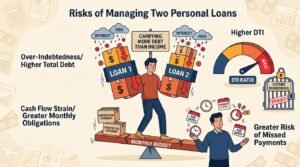
The biggest risk is taking on more debt than your income can comfortably support.
Two loans can increase your monthly financial obligations and leave less room for unexpected expenses.
Other potential risks include:
Higher Total Interest
Each loan can generate its own interest charges. Having two balances may increase the total amount you pay over time.
Greater Monthly Obligations
Two loan payments can make your monthly budget less flexible.
Higher DTI
The additional loan payment can increase your debt-to-income ratio, which may affect future borrowing applications.
Greater Risk of Missed Payments
Managing multiple due dates can make repayment more complicated. Missing payments can result in fees and potentially negative credit reporting.
When Might a Second Personal Loan Make Sense?
A second personal loan may be considered when the borrower has a clear financial purpose and enough income to comfortably manage both payments.
For example, someone may need additional financing for a separate major expense while continuing to repay an existing loan.
However, the new loan should be evaluated based on its total cost rather than simply whether the lender approves the application.
Before borrowing, calculate the combined monthly payments and determine how they fit into your overall budget.
How to Improve Your Chances of Qualifying
If you are considering a second personal loan, several steps may help you prepare.
First, review your credit report and make sure the information is accurate.
Next, calculate your current DTI and include your existing personal loan payment.
You should also review your monthly budget and determine how much additional payment you can realistically handle.
When comparing lenders, look at the APR, fees, loan term, monthly payment, and total repayment amount.
Avoid submitting unnecessary applications to multiple lenders without first checking their eligibility requirements.
Should You Have Two Personal Loans?
Having two personal loans is not automatically a problem, but it increases your financial responsibilities.
The key question is whether you can comfortably manage both loans while continuing to cover your regular expenses and maintain other financial goals.
Before accepting a second loan, consider the total amount of debt you will have, the combined monthly payments, the interest costs, and how the additional debt may affect future borrowing.
A lender’s approval does not necessarily mean that the loan is affordable for your individual budget.
Final Thoughts
You can have two personal loans at the same time, depending on the lenders and your financial circumstances. However, a second loan creates another monthly payment and can increase your total debt and debt-to-income ratio.
Lenders may consider your income, credit history, existing loan payments, DTI, and other financial information before approving additional borrowing.
If you are considering a second personal loan, calculate the combined payments first and compare the complete cost of borrowing. Make sure the additional debt fits comfortably within your budget before accepting the loan.
Managing two loans successfully requires consistent payments, careful budgeting, and a clear understanding of the total borrowing cost.